

Foreword
Before H. P. Lovecraft gave readers lost cities beneath the sea, forbidden books, ancient cults, and sleeping gods whose awakening might shatter the human mind, he wrote “Dagon.” Brief and deceptively simple, the story contains the essential elements of the strange fictional universe that would later make Lovecraft one of the most influential writers of supernatural horror.
The narrator begins not as an adventurer or investigator, but as a condemned man attempting to leave behind an explanation. His account is presented as a final testament, written under the shadow of death and complicated by his dependence on morphine. From the opening paragraphs, Lovecraft denies the reader any secure foundation. The narrator may be truthful, delusional, traumatized, or some combination of all three. Yet the terror of the story does not depend upon proving him reliable. It depends upon the possibility that he has seen something real.
That uncertainty is central to Lovecraft’s method. His protagonists rarely confront evil in the conventional sense. They discover instead that reality is far older, larger, and less hospitable than human beings have imagined. The universe does not revolve around humanity, and its hidden powers do not necessarily hate us. Hatred would imply attention. Lovecraft’s greater terror is indifference, the recognition that human civilization may be only a temporary disturbance on the surface of an ancient and incomprehensible world.
In “Dagon,” this realization begins with isolation. Cast adrift during wartime, the narrator escapes one danger only to enter a landscape more disturbing than captivity. The familiar ocean has withdrawn, exposing a vast plain of black mud and decaying matter. Lovecraft transforms the seabed into an alien planet, though it lies beneath the waters of Earth. The effect is profoundly disorienting. Nothing supernatural has yet appeared, but nature itself has become grotesque. The ground beneath the narrator’s feet is not meant to be seen by human eyes.
This setting reflects one of Lovecraft’s enduring themes: forbidden knowledge is often hidden not because someone concealed it, but because ordinary conditions prevent us from perceiving it. The ocean, the darkness, the passage of time, and the limitations of the human senses serve as merciful barriers. When those barriers fail, the result is not enlightenment but horror.
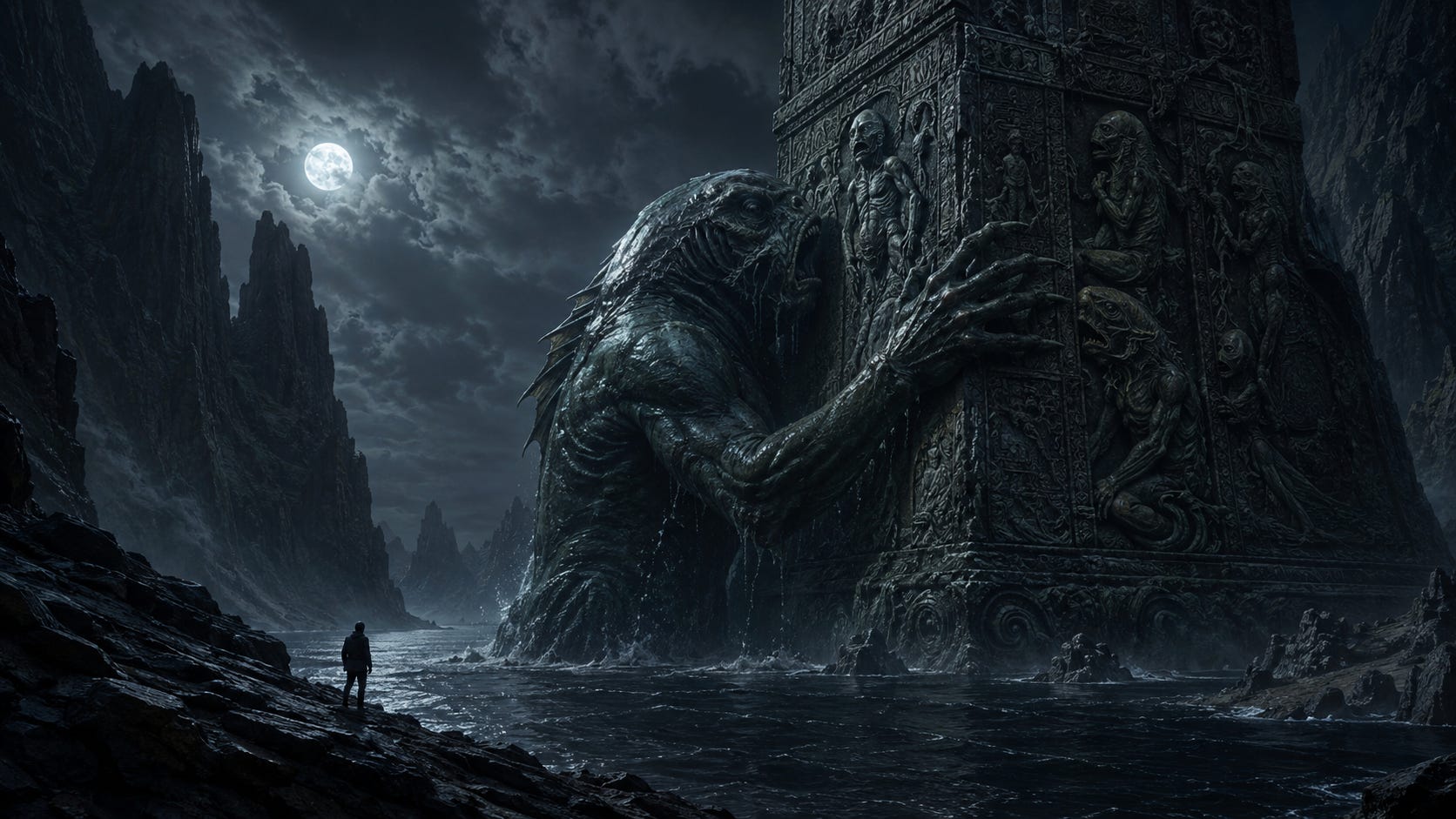
The object the narrator discovers on the exposed seabed deepens that horror. It suggests history, worship, and intelligence where none should exist. The carvings offer evidence of a civilization older than humanity’s records and perhaps older than humanity itself. They also force the narrator to reconsider familiar myths. What people dismiss as primitive superstition may be a distorted memory of something once encountered and never fully understood.
The creature that follows is horrifying not merely because of its size or appearance. It is horrifying because it belongs there. The narrator is the intruder. The landscape, the monument, and the being form part of an order that existed before him and will continue after him. Lovecraft’s monster does not invade the human world in the manner of a traditional Gothic villain. Instead, the human world is revealed to be a thin and fragile province within the monster’s domain.
The title invokes Dagon, an ancient deity associated in later tradition with the sea and imagined by some writers as a fish-like god. Lovecraft does not offer a clear theology or mythology. He uses the name as a fragment, a human label attached to something that may exceed human religion. This approach would become characteristic of his later fiction. Names such as Dagon, Cthulhu, and Yog-Sothoth do not fully explain the beings they describe. They are linguistic approximations, attempts by limited minds to identify forces beyond ordinary comprehension.
Readers familiar with Lovecraft’s later work will recognize “Dagon” as an early expression of what came to be called cosmic horror. The story anticipates the submerged civilizations, hybrid beings, secret cults, and ancient oceanic powers that would appear more fully in tales such as “The Call of Cthulhu” and “The Shadow over Innsmouth.” It also introduces a recurring pattern: a solitary narrator encounters evidence that human knowledge is dangerously incomplete, survives physically, and discovers that survival offers no true escape.
Lovecraft’s prose is deliberately heightened. He builds atmosphere through repetition, accumulation, and the language of revulsion. His narrators often insist that what they witnessed cannot be described, then struggle desperately to describe it. The contradiction is part of the effect. Language becomes another inadequate human instrument, useful for suggesting the edges of horror but incapable of containing it.
Modern readers should also approach Lovecraft with an awareness of the prejudices that shaped both the man and portions of his fiction. His racial and cultural views were often abhorrent, even by the standards of many of his contemporaries. Those views cannot be dismissed as irrelevant to his work, particularly when his fear of degeneration, foreignness, and social change enters his fictional worlds. Reading Lovecraft seriously requires neither excusing him nor refusing to acknowledge his artistic importance. It requires holding both truths at once.
“Dagon” endures because its central fear reaches beyond the circumstances of its author. The story asks what would happen if the world ceased to appear familiar, if the sea surrendered evidence of an older reality, and if one human being glimpsed the true scale of existence. Its horror lies not in a prolonged confrontation, but in a revelation. Once the narrator has seen what waits beyond the boundaries of accepted knowledge, he cannot return to ordinary life.
The story is short, but its implications are vast. Beneath the waves, beneath history, and perhaps beneath the structures of human reason, something ancient remains. The waters have hidden it for now. Lovecraft invites us to consider what might happen when they withdraw.
Gio Marron
Video by Gates of Imagination YouTube channel*
Narrated by Gates of Imagination
*Not affiliated with The Elephant Island Chronicles.
DAGON
H. P. Lovecraft
I am writing this under an appreciable mental strain, since by tonight I shall be no more. Penniless, and at the end of my supply of the drug which alone makes life endurable, I can bear the torture no longer; and shall cast myself from this garret window into the squalid street below. Do not think from my slavery to morphine that I am a weakling or a degenerate. When you have read these hastily scrawled pages you may guess, though never fully realise, why it is that I must have forgetfulness or death.
It was in one of the most open and least frequented parts of the Pacific that the packet of which I was super-cargo fell a victim to the German sea-raider. The great war was then at its very beginning, and the enemy’s navy had not reached its later degree of ruthlessness, so that our vessel was made legitimate prize, whilst we of her crew were treated with all the fairness and consideration due us as naval prisoners. So liberal, indeed, was the discipline of our captors, that five days after we were taken I managed to escape alone in a small boat with water and provisions for a good length of time.
When I finally found myself adrift and free, I had but little idea of my surroundings. Never a competent navigator, I could only guess vaguely by the sun and stars that I was somewhat south of the equator. Of the longitude I knew nothing, and no island or coast-line was in sight. The weather kept fair, and for uncounted days I drifted aimlessly beneath the scorching sun; waiting either for some passing ship, or to be cast on the shores of some habitable land. But neither ship nor land appeared, and I began to despair in my solitude upon the heaving vastnesses of unbroken blue.
The change happened whilst I slept. Its details I shall never know; for my slumber, though troubled and dream-infested, was continuous. When at last I awaked, it was to discover myself half sucked into a slimy expanse of hellish black mire which extended about me in monotonous undulations as far as I could see, and in which my boat lay grounded some distance away.
Though one might well imagine that my first sensation would be of wonder at so prodigious and unexpected a transformation of scenery, I was in reality more horrified than astonished, for there was in the air and in the rotting soil a sinister quality which chilled me to the very core. The region was putrid with the carcasses of decaying fish, and of other less describable things which I saw protruding from the nasty mud of the unending plain. Perhaps I should not hope to convey in mere words the unutterable hideousness that can dwell in absolute silence and barren immensity. There was nothing within hearing, and nothing in sight save a vast reach of black slime; yet the very completeness of the stillness and homogeneity of the landscape oppressed me with a nauseating fear.
The sun was blazing down from a sky which seemed to me almost black in its cloudless cruelty; as though reflecting the inky marsh beneath my feet. As I crawled into the stranded boat I realised that only one theory could explain my position. Through some unprecedented volcanic upheaval, a portion of the ocean floor must have been thrown to the surface, exposing regions which for innumerable millions of years had lain hidden under unfathomable watery depths. So great was the extent of the new land which had risen beneath me, that I could not detect the faintest noise of the surging ocean, strain my ears as I might. Nor were there any sea-fowl to prey upon the dead things.
For several hours I sat thinking or brooding in the boat, which lay upon its side and afforded a slight shade as the sun moved across the heavens. As the day progressed, the ground lost some of its stickiness, and seemed likely to dry sufficiently for traveling purposes in a short time. That night I slept but little, and the next day I made for myself a pack containing food and water, preparatory to an overland journey in search of the vanished sea and possible rescue.
On the third morning I found the soil dry enough to walk upon with ease. The odor of the fish was maddening; but I was too much concerned with graver things to mind so slight an evil, and set out boldly for an unknown goal. All day I forged steadily westward, guided by a far-away hummock which rose higher than any other elevation on the rolling desert. That night I camped, and on the following day still traveled toward the hummock, though that object seemed scarcely nearer than when I had first spied it. By the fourth evening I attained the base of the mound which turned out to be much higher than it had appeared from a distance; an intervening valley setting it out in sharper relief from the general surface. Too weary to ascend, I slept in the shadow of the hill.
I know not why my dreams were so wild that night; but before the waning and fantastically gibbous moon had risen far above the eastern plain, I was awake in a cold perspiration, determined to sleep no more. Such visions as I had experienced were too much for me to endure again. And in the glow of the moon I saw how unwise I had been to travel by day. Without the glare of the parching sun, my journey would have cost me less energy; indeed, I now felt quite able to perform the ascent which had deterred me at sunset. Picking up my pack, I started for the crest of the eminence.
I have said that the unbroken monotony of the rolling plain was a source of vague horror to me; but I think my horror was greater when I gained the summit of the mound and looked down the other side into an immeasurable pit or canyon, whose black recesses the moon had not yet soared high enough to illumine. I felt myself on the edge of the world; peering over the rim into a fathomless chaos of eternal night. Through my terror ran curious reminiscences of Paradise Lost, and of Satan’s hideous climb through the unfashioned realms of darkness.
As the moon climbed higher in the sky, I began to see that the slopes of the valley were not quite so perpendicular as I had imagined. Ledges and outcroppings of rock afforded fairly easy footholds for a descent, whilst after a drop of a few hundred feet, the declivity became very gradual. Urged on by an impulse which I cannot definitely analyse, I scrambled with difficulty down the rocks and stood on the gentler slope beneath, gazing into the Stygian deeps where no light had yet penetrated.
All at once my attention was captured by a vast and singular object on the opposite slope, which rose steeply about a hundred yards ahead of me; an object that gleamed whitely in the newly bestowed rays of the ascending moon. That it was merely a gigantic piece of stone, I soon assured myself; but I was conscious of a distinct impression that its contour and position were not altogether the work of Nature. A closer scrutiny filled me with sensations I cannot express; for despite its enormous magnitude, and its location in an abyss which had yawned at the bottom of the sea since the world was young, I perceived beyond a doubt that the strange object was a well-shaped monolith whose massive bulk had known the workmanship and perhaps the worship of living and thinking creatures.
Dazed and frightened, yet not without a certain thrill of the scientist’s or archaeologist’s delight, I examined my surroundings more closely. The moon, now near the zenith, shone weirdly and vividly above the towering steeps that hemmed in the chasm, and revealed the fact that a far-flung body of water flowed at the bottom, winding out of sight in both directions, and almost lapping my feet as I stood on the slope.
Across the chasm, the wavelets washed the base of the Cyclopean monolith; on whose surface I could now trace both inscriptions and crude sculptures. The writing was in a system of hieroglyphics unknown to me, and unlike anything I had ever seen in books; consisting for the most part of conventionalized aquatic symbols such as fishes, eels, octopi, crustaceans, molluscs, whales, and the like. Several characters obviously represented marine things which are unknown to the modern world, but whose decomposing forms I had observed on the ocean-risen plain.
It was the pictorial carving, however, that did most to hold me spellbound. Plainly visible across the intervening water on account of their enormous size, were an array of bas-reliefs whose subjects would have excited the envy of a Doré. I think that these things were supposed to depict men—at least, a certain sort of men; though the creatures were shewn disporting like fishes in waters of some marine grotto, or paying homage at some monolithic shrine which appeared to be under the waves as well. Of their faces and forms I dare not speak in detail; for the mere remembrance makes me grow faint. Grotesque beyond the imagination of a Poe or a Bulwer, they were damnably human in general outline despite webbed hands and feet, shockingly wide and flabby lips, glassy, bulging eyes, and other features less pleasant to recall. Curiously enough, they seemed to have been chiselled badly out of proportion with their scenic background; for one of the creatures was shown in the act of killing a whale represented as but little larger than himself.
I remarked, as I say, their grotesqueness and strange size; but in a moment decided that they were merely the imaginary gods of some primitive fishing or seafaring tribe; some tribe whose last descendant had perished eras before the first ancestor of the Piltdown or Neanderthal Man was born. Awestruck at this unexpected glimpse into a past beyond the conception of the most daring anthropologist, I stood musing whilst the moon cast queer reflections on the silent channel before me.
Then suddenly I saw it. With only a slight churning to mark its rise to the surface, the thing slid into view above the dark waters. Vast, Polyphemus-like, and loathsome, it darted like a stupendous monster of nightmares to the monolith, about which it flung its gigantic scaly arms, the while it bowed its hideous head and gave vent to certain measured sounds. I think I went mad then.
Of my frantic ascent of the slope and cliff, and of my delirious journey back to the stranded boat, I remember little. I believe I sang a great deal, and laughed oddly when I was unable to sing. I have indistinct recollections of a great storm some time after I reached the boat; at any rate, I know that I heard peals of thunder and other tones which Nature utters only in her wildest moods.
When I came out of the shadows I was in a San Francisco hospital; brought thither by the captain of the American ship which had picked up my boat in mid-ocean. In my delirium I had said much, but found that my words had been given scant attention. Of any land upheaval in the Pacific, my rescuers knew nothing; nor did I deem it necessary to insist upon a thing which I knew they could not believe. Once I sought out a celebrated ethnologist, and amused him with peculiar questions regarding the ancient Philistine legend of Dagon, the Fish-God; but soon perceiving that he was hopelessly conventional, I did not press my inquiries.
It is at night, especially when the moon is gibbous and waning, that I see the thing. I tried morphine; but the drug has given only transient surcease, and has drawn me into its clutches as a hopeless slave. So now I am going to end matters, having written a full account for the information or the contemptuous amusement of my fellow-men. Often I ask myself if it could not all have been a pure phantasm—a mere freak of fever as I lay sun-stricken and raving in the open boat after my escape from the German man-of-war.
This I ask myself, but ever does there come before me a hideously vivid vision in reply. I cannot think of the deep sea without shuddering at the nameless things that may at this very moment be crawling and floundering on its slimy bed, worshipping their ancient stone idols and carving their own detestable likenesses on submarine obelisks of water-soaked granite. I dream of a day when they may rise above the billows to drag down in their reeking talons the remnants of puny, war-exhausted mankind—of a day when the land shall sink, and the dark ocean floor shall ascend amidst universal pandemonium.
The end is near. I hear a noise at the door, as of some immense slippery body lumbering against it. It shall not find me. God, that hand! The window! The window!
Text courtesy of Wikisource: Dagon by H.P. Lovecraft
Also available on AMAZON: Dagon by H.P. Lovecraft
The Elephant Island Chronicles is a reader-supported publication. To receive new posts and support my work, consider becoming a free or paid subscriber.
Do you like what you read but aren’t yet ready or able to get a paid subscription? Then consider a one-time tip at:
https://www.venmo.com/u/TheCogitatingCeviche

Ko-fi.com/thecogitatingceviche