Voice-over provided by Eleven Labs
Foreword by Gio Marron
Glenway Wescott’s “Fire and Water” turns a familiar rural landscape into something quietly harrowing. At first glance it is a story about a small farming community, a drunken laborer, and his worn-out family. Underneath, it is a study of exhaustion, both of land and of lives, and of what happens when someone who has been trapped too long finally chooses an exit that others will not understand.
The narrator stands at the edge of things. He is neighbor, observer, and sometimes helper, but never fully involved. That distance matters. Wescott gives us a world seen from the road: people met between farm and village, glimpsed at porch rails, in barnyards, at the side of a buggy or wagon. We come to know George Stearns and his family exactly as the narrator does, in fragments and passing encounters, never through a grand confession. The result is a story built from glimpses, where small details accumulate into something weightier than any single scene.
The first part of the story belongs to George Stearns and the farm that mirrors him. The land is gullied, washed out, and neglected, a place that once had a fighting chance when someone cared enough to shore it up with stone and manure and hard discipline. George has no such discipline. His drinking is casual and constant, a public habit that everyone knows and half excuses. Neighbors see him lying in ditches or staggering home in all weather, and they indulge him, almost fondly. Wescott does not write George as a monster. He is weak rather than cruel, and that is part of the tragedy. His “manly weakness,” as the narrator notes, is something people are willing to pardon, and that willingness exacts its cost from the women who share his life.
The real center of the story is Amelia. She grows up in a house that looks like a dry-goods box, hemmed in by “rotten trees” and a swamp. From childhood she labors without pause: milking, carrying swill, working at butchering time, watching sows through the night so they do not devour their young. She bears the double load of bad land and a father who will not improve it. Her mother’s complaints fixate on appearance, the shame of having the worst-looking place in the county, but Amelia’s bitterness runs deeper. Where her mother frets about rusting tools and mangy horses, Amelia sees the stillness, the suffocating quiet, the sense that the house and the people inside it are slowly sliding into the swamp.
Wescott’s handling of Amelia is restrained and unsentimental. He does not present her as a patient saint, nor as a melodramatic rebel. She is strong, sharp, resentful, and fully aware of how trapped she is. Her brief courtship with Nick Richter, the disappointed drifter who fishes the lake and becomes her husband, feels less like romance than an experiment in escape. The image of the two of them in the boat, with Nick’s head in her lap and her face marked by a “vague, pale look of ecstasy,” hints at a desperate hope rather than any confident future.
The turning point of the story arrives with the fire at the Stearns place. Wescott keeps the facts minimal and the interpretation open. The mare and cart are gone, the washing has been taken off the line, the coals in the stove were nearly out when the narrator stopped by earlier, and Amelia once said she could never “go off and leave that house, everything the way it’s always been.” These clues are enough to suggest intention without any direct admission. Neighbors speculate about insurance; the narrator quietly dismisses that idea. Wescott refuses to tidy up the moral question. Did Amelia and Nick commit a crime, or did they finally act against a life that was eroding them as surely as the rain eroded their fields? The story leaves that judgment to the reader.
In the final section, years later, we see what became of them. The scene shifts to a shabby traveling carnival, with its calliope music, tired performers, and cheap entertainments. Here, among worn tents and painted promises, Amelia reappears, transformed. She is now heavy, bejeweled, seated in a ticket booth with the composure of someone who has, at last, chosen her own confinement. Her life is still rough, but the silence is gone. Movement, noise, and the constant churn of faces have replaced the dripping well and the oppressive trees. Nick, meanwhile, is still restless and aggrieved, his public bluster unable to hide his private disappointment.
“Fire and Water” is not a simple contrast between country and carnival, virtue and vice, or duty and betrayal. It is more skeptical than that. Wescott presses the reader to think about what counts as an acceptable escape, who gets forgiven, and why. George’s lifelong drinking is shrugged off as a failing the community can tolerate. Amelia’s final act, by contrast, is something people whisper about in pairs. In the end, the story suggests that some forms of destruction are socially manageable, and others are not, even when they arise from the same exhausted soil.
Read with attention to small details, this story rewards a slow pace. The images of land and weather, the small gestures in kitchens and barns, the offhand remarks at funerals and fires, all carry more than they first appear to. Wescott does not raise his voice. He lets ordinary people in an ordinary corner of the world reveal, almost casually, what it costs to live too long in a place that offers no future and no sound except the slime dripping in the well.
Gio Marron
Fire And Water
By Glenway Wescott
Chapter I
The sky rolled from side to side like an animal in pain, outstretched on the soft, saturated trees. Now and again there was a groan of thunder, and lightning flickered with a glitter of enormous eyes, rolling in their sockets.
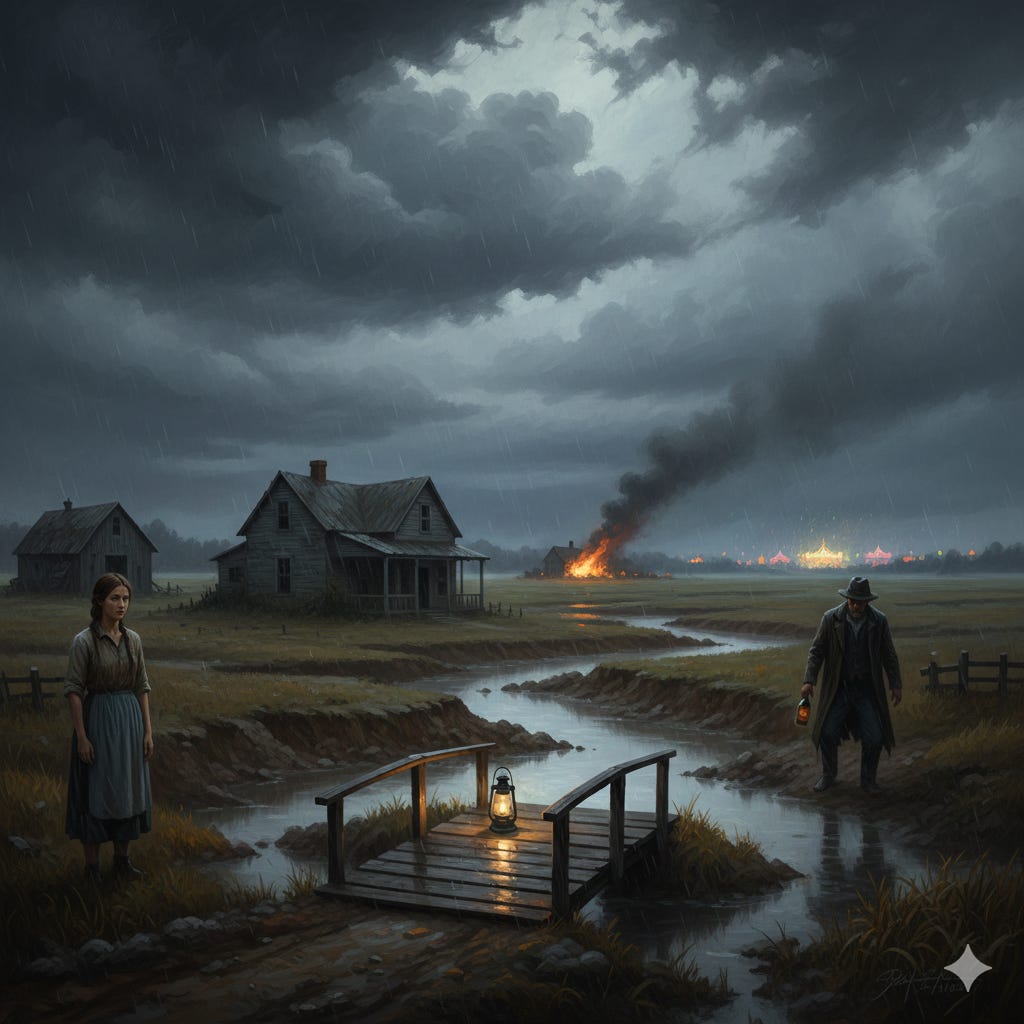
I was driving back to my father’s farm from the village. The downpour beat on the buggy-top, splashing to the ground and spattering the rubber laprobe. I disliked the smell of the wet harness leather and the sweating horse, wishing to enjoy the sour fragrance of the vegetation half-floating, half-rooted, in the fields. The lantern hanging from the dashboard hollowed out a space in the darkness into which the rain poured as bright as tin.
As I crossed a small bridge the lantern-light fell for a moment on the dripping hat and red face of a man who was leaning against the cement rampart. It was a neighbor named George Stearns. Should I have stopped to give him a lift? He was less than half a mile from home; he would be drunk and troublesome, furthermore I should have had to wake his wife and daughter, while he alone would roll quietly into the hay-mow.
It was his custom to return from the village in this condition three or four nights in the week, always on foot, since his daughter Amelia would not let him take the horse. His drunkenness was proverbial, and every one who used that road had seen him stumbling through the underbrush, collapsing backwards into a ditch, or drawn up patiently out of the way of hoofs and wheels. Weather meant nothing to him; he dug his way through the drifts, lay in the mud, lurched into cold creeks, but always got home. He was well liked by his neighbors, who took a certain pleasure in pardoning a manly weakness, and praised his good nature whenever his bad habit was mentioned. One autumn, having swigged too frequently from a bottle behind a beam in the wagon-shed, he dropped his pitchfork into the hopper of a threshing-machine, spoiling the blades which cut the twine; but after the owner had cursed and threatened, he was not even forced to pay for the damage.
As I passed the lamp rolled low, which Amelia always left in a window to guide her father, I remembered a story I had heard, how at the age of eight George had disappeared for a night and most of a day. His family had lowered a lantern into the well, and shouted in the woods around the sugar-bush, thinking of wild cats and wolves, which still came out of the deep forests from time to time to carry off lambs and ravish the chicken coops. His hysterical mother peered into the bear’s pen, half-expecting to see strips of clothing on the ground and blood on the animal’s tusks. The whole countryside was aroused. At last, after a mournful meal, his father had gone into the basement with a candle and a pitcher to bring up cider, and found the boy, drunk beside a barrel.
I thought then how one came to know people by the accumulation of glimpses; the sight of George, wet and drunk on the little bridge, a moment too fleeting even to speak to him; and after that his solitude and my solitude, in which my memory assembled other casual words and brief encounters. In that country I met my neighbors chiefly on the road. Thickets and piles of brushwood, the gravel, the puddles, the barbed-wire fences, the hitching-posts, and the piazzas, filled the corners of every picture of their lives. A one-horse vehicle brought me near them, like the field-glasses with which a naturalist detects a bird in a tree, though its plumage is the color of the tree. All my relations with George Stearns and his family, for example, were of this kind: the talk of one of them and myself in a buggy, or between one in a buggy and one standing beside the wheel or on a porch; the look of one of them in a barnyard or a field...
Thus about the nucleus of George’s face in the rainstorm, previous impressions gathered, later images and later conversations were to gather, rounding out a pointless history. Recollections of similar men’s lives served as intuition into his life, so that, as I turned in at my father’s gate, I could see him behind me in the darkness, blustering and hiccoughing, slipping down in the flooded grass, I could hear his obstinate sighs in the wind as it pulled the clouds away.
His eighty-acre farm was a miserable piece of property. Gashed with gullies, the fields of red clay sloped acutely above the house and barn, which were almost hidden in the edge of a swamp. A lake lay like an immense ditch in the center of this swamp, and into it the rains carried the topsoil from increasingly arid fields. George’s father had understood the weakness of his farm, and had kept the upper acres in sod-crops, filled the gullies with stone, planted clover to nourish the soil, rotted the grain-straw in the barnyard, and carted it with manure into the fields. But George preferred to forget these hard expedients, and the farm became, as it were, a portrait of himself. He planted only a little oats for the horse, a little corn for the cattle. The fences tottered and fell under loads of woodbine and wild grapes. In great pastures full of thistles two or three sharp-hipped cows gnawed the june-grass that grew between the stones.
George hired out by the day to his more ambitious neighbors. He was satisfied with this way of life; to move from farm to farm without responsibility, to work without haste or worry, to spend his earnings and his leisure in a saloon. The lot of his wife and daughter was not so agreeable. They lived like a pair of domestic animals in a pen: coarse trees on three sides, the tantalizing road on the other; no variety of duty or scene, no entertainment, no plans, nothing to expect. Inevitably their poverty would pinch closer and closer, and they were bound to a man who was happy and didn’t care.
At first Amelia seemed to bear it better than her mother. As a tall, wry-faced girl Mrs. Stearns, having been assured by her brothers that she need not expect to be courted for her looks, had married George to avoid becoming an old maid. George’s mother had suggested that he might settle down when he married, and she had to take the risk. The little house like a dry-goods box had seemed, in those days, a respectable home; but other people’s prosperity had built all around it, to its shame, incomparable mansions with turrets, lightning-rods, and picketting around the chimneys, incomparable hip-roofed barns with the name of the owner stencilled under crossed flags; and George’s house had deteriorated with his land and himself. Mrs. Stearns fretted less at her husband’s shortcomings than at the looks of the place.
“Everything’s goin’ to pieces,” I heard her complain one day. “It’s the worst lookin’ place in the county. Look at that broke rig with the weeds growin’ through the wheels. The tools all out gettin’ rusted. I’ll be switched if the mare don’t look mangy!”
“Oh stop it, Ma!” Amelia muttered. “I’m tired of that kind of talk!”
“Nobody goes by on the road,” her mother went on, “nothin’ to see, nothin’ to do. And me sick. Your pa gets the best of it, he gets out among folks. We women don’t get no further’n you could throw a stone.”
Amelia marched across from the sink, her round shoulders raised, shaking her dish-towel angrily. “Who’s to blame for this God-awful marsh? What’s the good of whimperin’? Who’s to blame, I ast you? Better go to bed, Ma, and rest.”
When the girl went out to do her milking, the sick woman shuffled off to bed. If it rained she tossed back and forth on her bed, kept awake by the water which gushed in all the gullies, washing the best of their land down to the lake. The temporary rivers gurgled and grew thick, without foam, and ended as suddenly as they had begun. It seemed that soon there would be nothing but rocks between the fences.
Amelia was a short, flat-chested girl with muscular arms and extremely wide hips. Her chapped and freckled skin seemed to have been drawn tightly over the bones of her face, over the long nose, the cheek-bones exactly in the center of her cheeks, the receding but stubborn chin, a face in which were combined poor health and great strength. Her eyelids fluttered so much that one could not remember the eyes, and her thin lips pouted habitually.
She did all the work, had always done it. As a child she went to school only during the winter months, and ceased altogether at fourteen when the school inspector could not force her to go. She kept the house decently clean, baked, churned butter, made her own clothes, and nursed her increasingly bed-ridden mother. Then there were the chores: she gave the cattle frozen corn-fodder to supplement the straw which they ate from the stack, milked them, and took the can to the cheese factory, and pumped from the stinking vat her share of whey for the pigs. I had seen her staggering down ditches which she had shovelled in the snow drifts, her long arms almost pulled from their sockets by the slopping pails of swill, or stooping over the smoke from a kettle-shaped stove which melted the ice in the water-trough. At butchering time she worked elbow to elbow with the men, scraping the bristles from the carcass soused in boiling water, and she alone cut up the pigs, rubbed and smoked the bacon, and ground the sausage. She watched over the old sows when they farrowed, sometimes far into the night, lest they eat their young. Her last duty was to turn down the lamp in the kitchen window where her father could see it as he stumbled up the road.
In October I was driving to the village before dawn to meet a cousin at the station. An odor, iced and musky, came out of the woods. The dewy red leaves looked swollen, and the thickets very large with mist. My horse was willing, and I enjoyed the road, pointed like a rod into distant hollows and forests or lifted up to pierce the sky, feeling an absolute solitude. But when I came near the Stearns farm I saw someone waiting for me. It was Amelia, and she waved, and when I stopped, gripped the wheel with her red hands and stared at me, her face very sharp as if whittled away.
“Gerson, won’t you stop and look at my pa. He’s sick. I’m scared, scared to wake him up.”
I followed her, not into the house, to my surprise, but into the barn, where the light fell with a feeble quiver from the two peepholes and innumerable cracks. Amelia pointed into the nearly empty hay-mow, where I saw first a pair of heavy boots, smeared with mud, the toes turned sharply outward, and beyond them George’s face, enormous, crimson, and disdainful, with hay in his hair and several stalks in his moustache.
“I’m sorry, Amelia. He’s dead.”
“Oh Lord... I thought so.”
“Is there anything I can do? Shall I tell anybody?”
“Well you can stop and tell Mrs. Bemis. You’re goin’ to the village? Tell an undertaker to come, the cheapest one.”
“Is that all?” I repeated, shocked by her perfunctory courage.
“Yeah, that’s all.” She sighed. “I got to wake up mother and tell her.”
Four months later she married a man named Nick Richter. Her mother expressed a peevish gratification: “Amelia couldn’t stand it, bein’ alone. I ain’t much company no more.” She grew weaker, and kept her newly married daughter at her bedside all that winter, exercising a tyranny with her eyes when she could not speak, and they buried her in April.
There was a large funeral, for during the six months by which she had survived her husband, the community had decided that she was a martyr to his drunken shiftlessness. Amelia asked my father and me to bring two teams to take people from the house to the cemetery, and she herself rode in my father’s carriage with her only living uncle, his wife, and another relative. But after the service she separated herself from her family and climbed into the front seat beside me, looking very tired, her face tight and yellow, her mouth twitching as if with anger.
“I couldn’t stand those sneaky women another minute. My Aunt Cynthy and Mrs. Smart, the old hens. They think I don’t show a proper feeling. They’ll start again’s soon as we get home, but I might’s well have a rest, I guess.”
“Good idea,” I said.
“Of course I’ll miss her and she was always good to me,” she added timidly, as if to please me, and buried her pale nose in a handkerchief.
To change the subject I asked, “Are you and Nick going to stay at the farm?”
“I s’pose so.”
“I thought you might try something else. The land isn’t much good, is it?”
“No good at all. Worn out, sandy, stones and ditches. It’s gettin’ now so’s it won’t raise grass, never was manured any. And the fences are all down. God, I hate it!”
I asked why.
“Well, not just because it’s poor farmin’. I don’ know, the woods maybe, those rotten trees so close. It’s no way to live; you see ’em all day and hear ’em all night. When I was a kid I used to be scared our house would slide into the lake. Was you ever down there? It just shows you what it’s always been like. If you fell in, you’d have some chance, but if you was always in...” Her voice weakened to a loud whisper. “You need some excitement. I never went nowhere, never saw nothin’, had to work. I guess you wouldn’t have the nerve to get out of a dead hole like that if you knew you got to come back. That’s why I never went to dances. I guess you’d jump into the lake for good, when you got home I mean.”
I felt uncomfortable. “Why don’t you sell the whole outfit and rent a house near town. Nick could make as much by the day as he does here.”
She did not seem to listen. “And it’s so awful still,” she muttered. “My God. It’s so still you can hear the slime dripping in the well.”
I renewed my encouragement. “Sell it and go to town. Nick could make two or three dollars a day. Don’t try to stick it out another year. Give yourself a chance. Have an auction,” I said.
“Oh Lord,” she cried. “Sell all that junk? It wouldn’t bring thirty cents. Spread all that rubbish round the yard for a lot of old women to pick over? I should say not.”
“Well, do something then,” I said impatiently. We were in sight of the house.
“Oh, I couldn’t,” Amelia moaned. “I couldn’t go off and leave that house, everything the way it’s always been. It’d be like leaving one of them, Ma or Pa, like not burying them,” she said.
Chapter II
Nick Richter had married to improve his position. His father, a blacksmith, having speculated in Texas oil, had been forced, just before he died, to sell his house, his shop, and every hammer and horseshoe. Nick disliked his father’s trade, and drifted in a radius of ten miles around the village, working by the day, week, or month, at odd jobs. He bought a horse and buggy when he could afford to, selling them if he lost his job, and looked for a wife at every Saturday and Sunday night dance for several years. But he danced with his jaw, his neck, and his elbows, and the boisterous girls merely laughed at him, so these entertainments left him lonely and discouraged.
The lake in the swamp below the Stearns house contained pickerel and black bass, which George had been too law-abiding as well as too lazy to exterminate with nets. Since the owner was a bed-ridden widow in Milwaukee, he was its virtual proprietor, and rented his flat-bottomed rowboat two or three times a week. Nick drove up before the barn one Sunday morning, two bamboo poles wagging behind his buggy, and Amelia showed him where to tie his horse and brought the heavy oars from the shed.
He was soon recognized as her beau. George had always puttered about the sheds on Sunday, and Amelia, leaving her chores to him, claimed her first regular holiday. They went to picnics, and drove from village to village, stopping at the saloons for soda and beer, and sat very late on the back porch. Sometimes they went to the lake to fish or pretend to fish.
I saw them there one morning just before George died, as I walked through the swamp on an old corduroy road. From the tall maples leaves floated to the ground like a harvest of ghostly oranges. Through a clearing I could see the murky hills, and when I approached the lake, the water glimmered between the boughs in mother-of-pearl strips. From the tottering boat-house a muddy channel led out through the reeds to a cup-shaped harbor, separated from the deep water by a sand bar. In this quiet place a few lilies grew, the yellow thrusting their closed, hard heads above the surface, the white spreading tufts of petals like miniature swans.
Here the boat was at rest, the oars hanging from the oarlocks. I stood on the shore for several minutes, unobserved, and then turned back into the woods. Nick crouched in the bottom of the boat, half-hidden, and Amelia, sitting on the broad back seat, held his head in her lap. Upon her face there was a vague, pale look of ecstasy, an ecstasy of possession without confidence and without hope.
There followed George’s death, their hasty marriage, the mother’s illness and death. By spring Nick must have recognized the sterility of the farm, for he put in only the patch of oats and the patch of corn, ploughed up the garden for Amelia, and began to hire out to his neighbors as George had done. He was a good worker in his sour, muttering way, his shoulders bent forward like the wings of a large hawk, his gaunt wrists extended stiffly. Perhaps his marriage was a disappointment; certainly he failed to feel the security of a man of property, the serenity of a married man, of which he may have dreamed. Perhaps he had been contaminated by Amelia’s discontent. Perhaps he was afraid of her: a weak swimmer who had ventured into what looked like a stagnant pool, to find himself in the embrace of a profound, indomitable current.
Early in the next harvest I stopped one afternoon to ask Amelia if Nick could help my father any day that week. The horizon was wrinkled with heat waves, the zenith as dark as a sea, and one never ceased to hear the growling of binders. In all the reaped fields the stubble was spotted with bindweed like drops of blood. As I turned down toward the swamp I observed the poverty of the fields there, the exhausted soil gaping through the grass, the thin stand of grain, the great parched gullies, the bogs where the birds shouted over the ripe weeds. The trees slept in the sunshine: not a leaf swayed, but sometimes one feathered prematurely to the ground.
My mare trotted in at Amelia’s gate under the poplars full of blackbirds. In the semicircle of forest the little house squatted, staring blindly from its windows. The sheds leaned against the barn. A sick dove staggered over the rocks by the water-trough. A little way from the kitchen door, some shirts and stockings and cotton sheets hung on a line stretched between two posts.
“Hello!” I shouted. No answer. “Amelia!” An echo, small and soft, came back from the woods: “Amee-lia!” I jumped out of the buggy and went up the steps, certain that if she had gone to town she would have taken in the washing. The kitchen smelled of boot-leather, manure, soft soap, and cooking, and there was another odor which I identified as that of moth-balls.
Could she be asleep? The pendulum of the clock creaked monotonously. I stepped inside and called again. The breakfast dishes lay in and around a dishpan of cold water, and the fire in the range was only a handful of pink coals. I felt the embarrassment of an empty house. Deciding that she had gone to the woods for blackberries, I drove away.
As I passed one of the farms owned by a man named Beacon, I saw him sitting on the lawn, a pitcher of water beside him, fanning his brick-red face with a newspaper. In hot weather he left the heavy work to his sons, since he weighed more than two hundred and fifty pounds. He beckoned to me and came down, wheezing and ponderous, to the road.
“As you went by Stearns’,” he asked, with the worried frown of a man who has a larger harvest than he can handle, “did you see anything of Nick?”
I shouted because he was deaf. “No, Mr. Beacon. I stopped at the house, but there wasn’t anybody there.”
“Whew,” he sighed. “Nobody there. Queer. Nick’s been helpin’ us out, and he hain’t showed up today. He al’ays sends word. I thought he must’a been sick.”
“It is funny,” I admitted. “Amelia wasn’t there either.”
“Well, it’s a new wrinkle for Nick,” he concluded mournfully.
I intended to stop at Amelia’s again, but as I came back from the village I detected in the air a faint bitterness of smoke, so faint at first that I thought it had drifted down from a forest fire in the north. When I came to the top of a hill I saw it, hanging in a black mushroom over the swamp. I touched the mare with my whip and rattled into the alley, where the smoke was thick and steady and the color of wheat-chaff, blowing slowly overhead.
It was the Stearns house. Through a hole in the roof a great draught lifted the flame as if in a chimney. The yard was full of men, whose faces in the ruddy light were strange and glistening. Sweat dripped on their blue shirts. They were fighting the fire eagerly and with some skill; already they had chopped away the flaming porch. Three men in turn worked the handle of the coughing, spurting pump, and bucket after bucket of water was passed from hand to hand and emptied.
I saw immediately that Amelia and Nick were not there. Some buggies and an auto had stopped along the road, and several women looked on with interest, their summer dresses and parasols lending to the catastrophe an air of picnic. Among the spectators, but near enough to make his orders heard above the crackle and roar of the fire, the shouts, the axes, the creak of the pump handle, old Beacon was enthroned on a dry-goods box.
“Well my boy,” he demanded, “what d’you think of this? Did they have any insurance?” He smiled wickedly.
Indignant at his suspicion, I tried to offer some explanation, to remember some clue. Then I shouted into his ear, “They hadn’t any insurance. I remember. Amelia asked father about it, and he told her not to bother, but to sell out when she had a chance.”
A look of perplexity, even of disappointment, passed across old Beacon’s face, that resembled a great, sagacious beet. He swelled his cheeks and blew wearily. “Well, I’ll be damned, anyway,” he said.
The roof fell, splitting like paper, and after that the fire diminished. The floor sent up smoke and steam, but no more flame. The kitchen stove crashed through the charred boards into the cellar.
“But I don’ know what these men are burstin’ themselves for at this job,” the old man said. “Looks to me like nobody’s goin’ to thank ’em for it. The mare and the cart’re gone.” He settled his damp cheeks in the folds of his neck.
“Oh,” I shouted half-heartedly, “I guess they’ve gone to town. They’ll be back, poor devils.”
“But I knew better.” My eyes had rested on the clothesline; the washing which had hung there was gone, and on the ground beneath in an uneven row the clothespins lay. I remembered the harmless dying coals in the range. I remembered the unwashed dishes and the odor of mothballs. I remembered what Amelia had said the day her mother was buried: “I couldn’t go off and leave that house, everything the way it’s always been.”
Had they been in the house? Had they heard me call? Had they been hiding there, in the other rooms or behind a door?
The fire left a ruin shaped like a charred pot. The men drew off, wet, black, tired, and puzzled, washed their faces at the pump and rolled down their sleeves. The horses were untied, everyone piled into one vehicle or another, and they drove away shouting; but those who spoke of the cause of the fire did so in pairs, very quietly.
From the charred and broken house the smoke went up straight to the sky. Now it was as soft as wool, now like a tower or shell. It widened over the swamp, casting a shadow upon the lake, and persisted until dusk with an even, melancholy trembling.
Chapter III
Years afterward, while I was stopping for a few days in a town in the western part of the State, a carnival set up its tents in a dance-hall park between the river and the tracks. I saw a van or two come down the main street, the horses’ fetlocks stirring up dust in clouds which settled on their sweaty backs and on the faces of the man with his cheeks full of tobacco and the hatchet-faced woman who sat on the packing cases and rolls of canvas. That night two of the vagrants appeared at the boarding-house table where I took my meals. The shuttered dining room smelled like a potato cellar where the sprouts have nosed their way upward and the scabby tubers have rotted for months, and when the landlady trotted out of the kitchen and set down platters of meat in slabs as large as her hand, the regular boarders looked with sick faces at their plates and at one another.
But the theatrical ladies ate with the silent heartiness of women paid to eat in a shop window as an advertisement of whatever they ate. Chemises of shadow lace showed through georgette shirtwaists, making their bodies look embossed with garlands and butterflies. Under mats of blondined hair fastened with rhinestone pins, their faces had an identical appearance of porcelain, the hard eyes surrounded by pencilled lashes and eyebrows, spots of orange rouge exactly between the nose and the ear. Their nails cut in triangles shone like celluloid. Grasping the knives and forks vigorously, their eyes unfocussed, their red mouths in motion, they ate the fat meat to the last drop of gravy, the soggy pie to the last crumb.
The next afternoon I crossed the iron footbridge with an aimless curiosity, into the Grove. The river was only a trickle from puddle to puddle and gave off an odor similar to that of cucumbers, and the reflections of narrow, green and yellow leaves upon its surface like the footprints of innumerable birds on a flat of mud.
Five great wagons and a mud-caked Ford were drawn up along the river. The horses grazed in an adjoining meadow, the sweat dried in flakes on their backs, switching at the flies and never lifting their heads to look at the noisy camp, unfolded from the loads which they had drawn.
In the center, like a fat woman pirouetting, the merry-go-round revolved laboriously. The mincing legs of its horses kicked out behind, their foamless lips were parted, and a pair of crimson tigers drew a chariot for those too timid or too large to go astride. The power which set the minute stallions and sky-blue bears gradually rocking and circling came from a steam engine like a short-necked bottle, whose whistle preceded the slapping and squeaking of the leather belts and the outburst of shrill tunes from the calliope, when all the passengers, mostly children, had been hoisted and set upright in the saddles.
A crowd of untidy women and shouting boys filled the alley between the tents. The refreshment booth, a great umbrella of canvas enclosed by planks laid from barrel to barrel, did a brisk business in ice-cream cones, in tepid drinks, in hot dogs and patties of ground meat stewing on a black griddle. A young man whose hair hung down in shoestrings and a plump woman with brown pouches beneath her eyes ran from side to side shouting, “What’s yours?” and “Don’t push please,” storing the nickels and dimes in a cash-register drawer which opened and shut with a grating noise.
Next to it stood a “hit-the-nigger-baby” establishment, a hierarchy of dolls, and a pile of baseballs with which to knock them down, and a display of bad cigars and felt pillow-covers for prizes. Though it was Saturday afternoon few men were there to patronize it, for those who had worked all morning in the heat naturally preferred to lie on couches indoors, with newspapers over their faces.
The showmen’s cheeks drooped with disillusionment and fatigue. Business was not good; business was never good, or never good enough. It was a hard life: shouting, luring, browbeating, laughing, and singing, eating the poorest food, counting the smallest coins, packing the tents, frayed finery, nigger-dolls, fangless rattlesnakes, and petrified Belgian babies; the boss and his wife going ahead in the Ford to rent the next park, the rest following slowly after the strong-smelling horses. They must have learned, the youngest Carnival Queen and the newest freak, that romance is for those who see, never for those who do, and underpaid as a profession.
I stopped to look at a picture of the dope-fiend, a moon-colored young man with scaly, presumably allegorical beasts nestling against his ribs. Hanging beside it were posters of Jocko, the Baboon-Man, who spoke the monkey language and ate raw meat, a snake charmer among her serpents which stood up in spirals as thick as trees, and the Fat Woman, a belted, brooched, and corsetted feather-bed, with oval fingers scarcely meeting across her tremendous chest. A nervous little man, who looked as if he might at any moment burst into tears, was lecturing a dozen people. I was not tempted by his promises, for I could hear the tremolo of the young man who would say, “Cigarette smoking has made me what I am today,” and the charmer crooning perfunctorily to her sick snakes; I could smell his ether and her toilet-water. I had seen a Wild Man from Java or Borneo or somewhere else who tore off the heads of live, squawking hens with his teeth and sucked their blood, and felt sure that this poor tent had nothing so sensational to offer.
The leaves of the maples, pockmarked and bleached by a common blight, loosened and glided through the windless air, the calliope played, the barkers grew hoarse, several babies cried. I went on to the next tent, labelled in great letters Gay Paree, joining the crowd which gathered to see a free show before the performance.
Three women and a negro stood on a platform like a large bench. The women wore diaphanous slips, all beads and fringe, which did not cover a row of pink and green legs, two of which were crooked and four very fat. I recognized the ladies of the boarding house. They stared at the crowd with the solemnity of caged animals, apparently trying to look voluptuous on the couchless, cushionless boards. One of them pulled her blouse away from her body and stared avidly inside it. The negro who stood sleepily beside them crouched now and began to pipe, drearily and loud, on a sort of flute. The women stiffened, their lips parted, the pupils of their eyes grew large and cold. Three arms were lifted, and all their bodies throbbed, paused, and throbbed again. Then each one curved her waist extremely, first to the right side, then to the left, and each seemed to spring upward and relax like a bow from which an arrow has been shot. Three shrill cries and a tapping of the negro’s foot marked the beat.
During the dance a woman came out of the tent behind the performers and sat down in the ticket-box. It was Amelia.
I was shocked and amazed. Seven years had passed. And the pair had vanished like a rock, not thrown, but laid in a pond. No one had suspected their intention, and after they went, their neighbors wondered why rather than where they had gone. The police could have traced them, but why should they have been traced? The farm, which was heavily mortgaged, went to a real estate agent who came out from time to time to stare at the ruin and to stamp over the miserable fields, not knowing what to do with them. Seven years ago... Doubtless some one found out what had become of them, but I had been away from home for years and had never heard.
Amelia had changed more than I, and at first I was afraid she would give me a wild welcome—to what? The tent was all she had. But in a few moments I began to doubt if she would have recognized her own father. She sat there above me like a figure in a jack-in-the-box, took out a roll of tickets like a pulley-wheel, and counted the change in a box. Her small eyes drifted heedlessly from dull face to dull face: so many strangers, so many fools, so many tickets to be sold! She had forgotten me, forgotten above all what I remembered.
She was grotesquely fat. Her narrow lips had been pressed together by rectangular cheeks, there were deep crevices at her wrists, and the sharp chin was lost in a succession of double chins gathered into a tight necklace of amber beads as large as cherries. Her hair was drawn up in a pompadour over a visible brown rat, her purple velvet dress had worn leathery at the elbows. But it was evident, by the way she sat in that booth like a pulpit, that all this meant progress and prosperity. Every distortion of her face, every aggrandizement of her body proclaimed her contentment. Soothed by movement and noise, gorged by excitement, the girl who had resembled years ago a wistful rat, was satisfied.
I looked about for Nick, and his appearance between the flaps, coat-tails first, as he argued with some one inside the tent, silenced the music and arrested the dancing. He came forward and began to harangue the onlookers and to shake his large fists, straining the frock-coat which was buttoned too tightly over his chest. He had not changed, unless exaggeration be a change: his glance was still hurt and ominous, and there was the suggestion of a curse in the tone of his voice. It was plain that the carnival had not been his salvation. Amelia did not look at him but nevertheless she seemed, in her fulfillment, to mock his angry hands, the furtive hope of his eyes, his mastiff-jaw that would never dare to snap.
“You have here, ladies and gentlemen,” he continued, smiling wanly, “the flower of Oriental art. It is no singing and dancing for children. There are things about it they would not appreciate. All these famous performers have appeared in Paris. The French do not relish tame entertainments. They like it hot, they like it strong. You have seen their free preliminary dance. It is only a sample of what they can do. The admission is ten cents. I advise you strongly to come in. The show starts in five minutes.”
The women and the negro sauntered down the steps behind the flap. Nick disappeared. Amelia began to tear off tickets and make change, and presently she followed, never glancing at the stragglers or at me.
I did not see them again. I did not need to hear their story. For in the dusty grove were tents, the brass throats of the calliope opened again, and the whole town throbbed with music. Those silences in which she had heard “slime dripping in the well” were vanquished.
The End
From all of us here at the Elephant Island Chronicles, we hope you have enjoyed this lesser-known classic story by Glenway Wescott. Until next time, stay curious.
Do you like what you read but aren’t yet ready or able to get a paid subscription? Then consider a one-time tip at:
https://www.venmo.com/u/TheCogitatingCeviche

Ko-fi.com/thecogitatingceviche