

Foreword
Some novels endure because they capture a particular moment in history. Others survive because they illuminate something permanent about human nature. Little Women belongs firmly in the second category. More than a century and a half after its publication in 1868, Louisa May Alcott’s story of the four March sisters continues to find new generations of readers who discover, often with surprise, that its concerns feel remarkably contemporary. Family, ambition, love, duty, financial uncertainty, personal identity, and the difficult transition from childhood to adulthood remain as relevant today as they were in nineteenth-century New England.
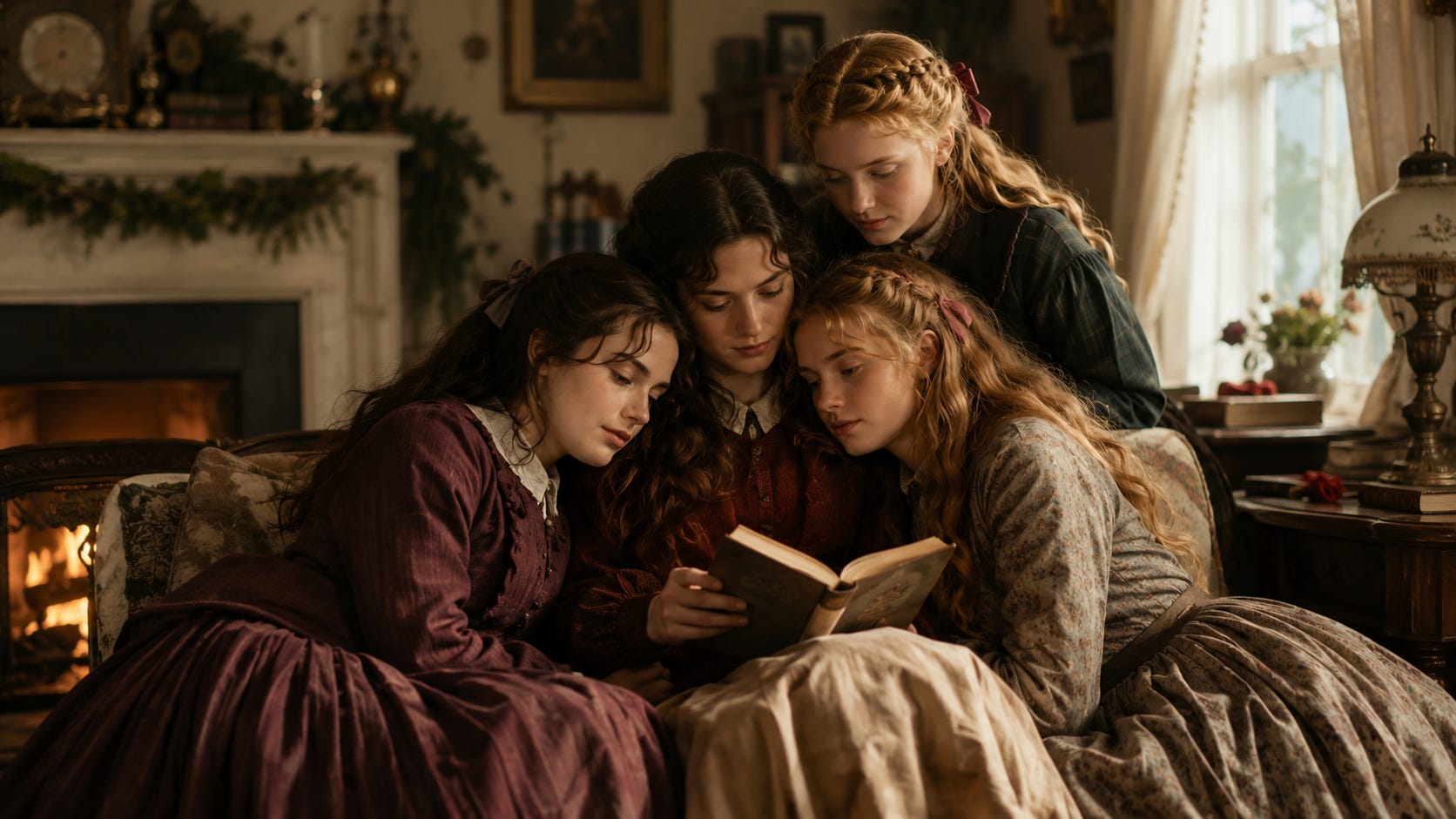
At first glance, the novel appears deceptively simple. The March family lives modestly while their father serves as a chaplain during the American Civil War. Their mother, affectionately known as Marmee, raises Meg, Jo, Beth, and Amy through a succession of everyday triumphs and disappointments. There are no sweeping battles, no elaborate mysteries, and few dramatic villains. Instead, Alcott builds her narrative from ordinary life: Christmas celebrations, neighborhood friendships, literary aspirations, family illnesses, first romances, and the countless small decisions that gradually shape character.
That simplicity is precisely the novel’s strength.
Louisa May Alcott drew heavily from her own experiences. The March sisters closely resemble Alcott and her own siblings, while Jo March reflects many aspects of the author’s personality. Like Jo, Alcott possessed an independent spirit, a love of writing, and a determination to support her family through her work. Although Little Women is not autobiography, its emotional authenticity owes much to the author’s intimate understanding of the hopes, frustrations, and responsibilities she describes.
Readers encountering the novel for the first time are often surprised by how modern Jo March feels. She refuses to fit comfortably within the expectations placed upon young women of her era. She longs for independence, meaningful work, and the freedom to define her own future. Yet Alcott avoids reducing her heroine to a symbol or a manifesto. Jo is impulsive, generous, stubborn, affectionate, and deeply flawed. Her mistakes are as important as her successes, making her one of literature’s most enduring and believable protagonists.
The other sisters are equally distinctive. Meg seeks dignity in domestic life while learning that happiness cannot be measured by wealth. Beth embodies quiet compassion without becoming merely sentimental. Amy matures from a sometimes vain and impatient child into a thoughtful woman whose artistic ambitions reveal unexpected depth. Together, the sisters offer different visions of adulthood rather than a single ideal. Alcott recognizes that people pursue fulfillment along different paths, and she grants each sister the dignity of her own journey.
The novel’s moral vision deserves particular attention. Modern readers occasionally mistake its lessons for simple Victorian moralizing. In reality, Alcott presents virtue not as rigid obedience but as continual self-improvement. Her characters fail repeatedly. They lose their tempers, envy one another, act selfishly, make poor decisions, and hurt those they love. Growth comes not through perfection but through honest reflection and persistent effort. In this respect, Little Women speaks across generations. It reminds us that character is formed gradually, often through quiet acts of kindness and perseverance rather than extraordinary accomplishments.
The world Alcott portrays was also undergoing profound change. Industrialization was reshaping American society, traditional family structures were evolving, and the Civil War had transformed the nation’s understanding of sacrifice and citizenship. Women increasingly sought educational and professional opportunities beyond those available to previous generations. Although Little Women never becomes overtly political, these broader currents quietly shape the lives of its characters. The novel stands at the intersection of an older America rooted in domestic ideals and a newer America offering expanding possibilities.
Part of the novel’s lasting appeal lies in its refusal to simplify life’s inevitable tensions. Ambition must be balanced with affection. Independence must coexist with responsibility. Dreams must sometimes yield to reality without surrendering hope. Alcott understood that adulthood rarely consists of dramatic revelations. More often, it is built through daily choices, imperfect compromises, and enduring relationships.
Readers should also remember that Little Women emerged from a literary culture quite different from our own. Victorian novels frequently pause for reflection, allowing characters to discuss ideas and moral questions that modern fiction often leaves unstated. Rather than viewing these moments as interruptions, it is helpful to see them as invitations. Alcott encourages readers to examine not only what her characters do but why they choose as they do. The result is a novel that rewards thoughtful reading, revealing new insights with each return.
Its influence on literature can scarcely be overstated. Countless coming-of-age stories, family sagas, and novels centered on the interior lives of young women owe something to Alcott’s achievement. The March sisters have become literary archetypes while remaining fully realized individuals. Adaptations for stage, film, and television continue to reinterpret their story because each generation recognizes its own questions within theirs.
Yet perhaps the greatest achievement of Little Women is that it never loses sight of the ordinary joys that give life meaning. It celebrates conversation around a dinner table, evenings spent reading together, acts of generosity between neighbors, the comfort of shared laughter, and the resilience of families facing hardship. These moments possess no spectacular grandeur, but Alcott suggests they are precisely the experiences from which a meaningful life is built.
As you begin this classic, resist the temptation to think of it merely as a beloved children’s book or a relic of another age. It is instead a thoughtful exploration of what it means to grow into adulthood with integrity, compassion, and purpose. The world has changed immeasurably since Louisa May Alcott first introduced readers to the March family, but the questions she asks remain our own.
That is why Little Women has never truly grown old. It continues to remind us that while circumstances change, the pursuit of a good life, lived with courage, generosity, and love, remains timeless.
Gio Marron
Video by Gates of Imagination YouTube channel*
Narrated by “Narration in this video is AI-generated. Olivia Lane is the voice name and does not refer to a real human narrator.”
*Not affiliated with The Elephant Island Chronicles.
Text courtesy of Project Gutenberg: Little Women; Or, Meg, Jo, Beth, and Amy by Louisa May Alcott
Also available on Amazon: Little Women
The Elephant Island Chronicles is a reader-supported publication. To receive new posts and support my work, consider becoming a free or paid subscriber.
Do you like what you read but aren’t yet ready or able to get a paid subscription? Then consider a one-time tip at:
https://www.venmo.com/u/TheCogitatingCeviche

Ko-fi.com/thecogitatingceviche