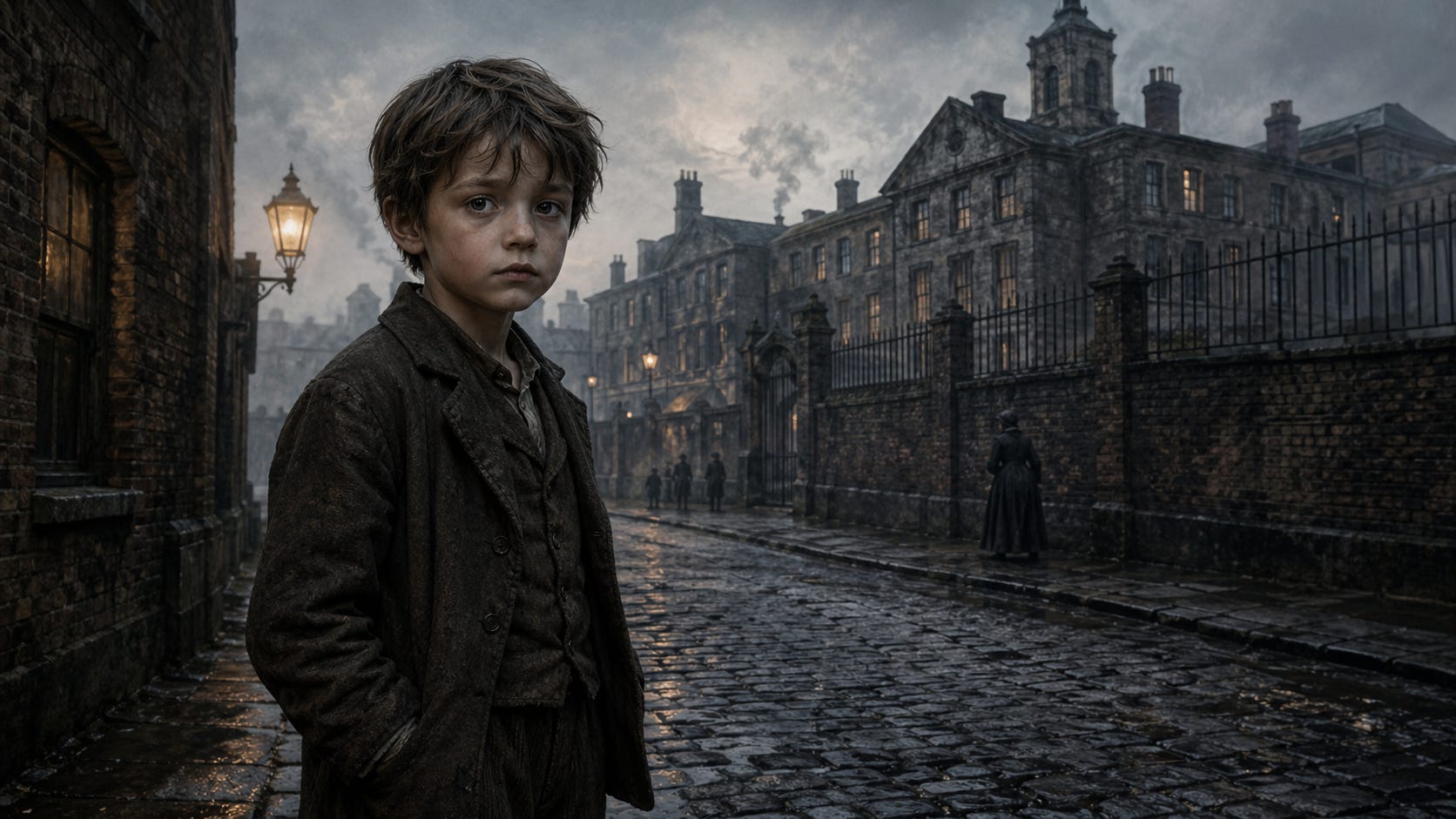
Foreword by Gio Marron
Few novels begin with a child so completely alone as Oliver Twist. Born in a workhouse, unnamed by family, unwanted by the world, Oliver enters life not as an heir, a son, or even a citizen in any meaningful sense, but as a burden to be processed. From its opening pages, Charles Dickens places the reader inside a society that has learned how to speak the language of charity while denying the reality of mercy.
First published serially between 1837 and 1839, Oliver Twist was Dickens’s second novel, written while he was still a young author rapidly gaining public attention. Yet the book already shows many of the qualities that would define his career: vivid characters, moral urgency, sharp social criticism, theatrical scenes, sudden reversals of fortune, and a deep sympathy for children exposed to adult cruelty. Dickens was not merely telling a story about poverty. He was challenging the respectable assumptions that allowed poverty to be managed, punished, and ignored.
The world Oliver enters is one shaped by institutions that claim to protect the vulnerable but often degrade them instead. The workhouse, the parish board, the courts, and the streets of London all become part of the novel’s moral geography. Dickens does not present evil only as personal wickedness, though the book has its share of memorable villains. He also shows how cruelty becomes routine when it is hidden inside systems, rules, ledgers, and official language. The famous scene in which Oliver asks for more food is powerful not because the request is outrageous, but because it is so modest. A hungry child asks for a little more gruel, and the adult world responds as though civilization itself has been threatened.
This is one reason Oliver Twist remains more than a Victorian social novel. Its details belong to nineteenth-century England, but its central questions are lasting ones. What happens to children when adults treat them as problems rather than persons? What does a society reveal about itself in the way it treats the poor, the orphaned, and the inconvenient? Can innocence survive in a world that profits from corruption? Dickens does not answer these questions with detached theory. He answers them through story, through faces, voices, rooms, alleys, courtrooms, sickbeds, and doorways.
The novel is also unforgettable because of its characters. Oliver himself is sometimes less psychologically complex than the figures around him, but that is part of his role in the story. He is a moral center, a child whose vulnerability exposes the character of everyone who encounters him. Around him, Dickens builds one of his early great casts: the brutal Bumble, the calculating Fagin, the terrifying Bill Sikes, the tragic Nancy, the artful Dodger, and the kindly figures who offer Oliver the protection he has been denied. These characters are drawn in bold colors, sometimes grotesque, sometimes sentimental, often larger than life. Yet their exaggeration serves a purpose. Dickens understood that social truths are often most clearly seen when magnified.
Modern readers may notice tensions in the novel. Dickens’s portrayal of Fagin, in particular, has long been criticized for its antisemitic elements. That criticism is justified and should not be dismissed. To read a classic honestly is not to pretend it is free of the prejudices of its age, nor to excuse those prejudices because the work is famous. It is to see the whole work clearly: its brilliance, its moral force, its blind spots, and its failures. Oliver Twist asks readers to recognize human dignity where society refuses to see it. That moral demand should also shape how we read the novel itself.
For all its darkness, Oliver Twist is not a hopeless book. Dickens believed in exposure. He believed that if readers could be made to see suffering plainly enough, they might be moved to moral action. His method was not subtle realism in the modern sense. He used melodrama, coincidence, pathos, humor, and horror, sometimes all within a few pages. But beneath these techniques is a serious conviction: that storytelling can make indifference harder to maintain.
The London of Oliver Twist is a place of fog, hunger, hidden rooms, criminal networks, and institutional coldness. Yet it is also a place where compassion still appears, sometimes unexpectedly. Dickens does not suggest that kindness is easy or that justice naturally triumphs. Rather, he insists that mercy must be chosen, often against the habits of the world. Oliver survives not because the system works, but because individuals refuse, at crucial moments, to behave as the system expects.
To read Oliver Twist today is to encounter one of Dickens’s first great acts of public imagination. It is a novel of pursuit, danger, mystery, and revelation, but also a protest against the reduction of human beings to social categories. Oliver is called many things: pauper, orphan, apprentice, criminal, burden. The novel’s deepest insistence is that before all of these, he is a child.
That insistence is why the story still matters. Dickens asks us to look at Oliver and then to look beyond him, toward every person made invisible by custom, policy, poverty, or convenience. The book begins with a child who has nothing, not even a name of his own. It endures because Dickens makes that child impossible to forget.
Gio Marron
Video by Gated of Imagination YouTube channel*
Narrated by Arthur Lane
*Not affiliated with The Elephant Island Chronicles.
Text courtesy of Project Gutenberg: Oliver Twist
Also available on Oliver Twist
The Elephant Island Chronicles is a reader-supported publication. To receive new posts and support my work, consider becoming a free or paid subscriber.
Do you like what you read but aren’t yet ready or able to get a paid subscription? Then consider a one-time tip at:
https://www.venmo.com/u/TheCogitatingCeviche

Ko-fi.com/thecogitatingceviche