
Voice-over provided by Eleven Labs
The Brick
By Ian Moreno
Inspired by Ezekiel 1 and 4.
The men who had been on the canal bank when the cloud came ran back to the camp ahead of him. Some shouted as they ran. Some did not. One of them did not stop running when he reached his own door, and his wife had to follow him into the back of the house and lead him out again the way you would lead out a child. The boy who watched the goats ran also, though the goats themselves stayed where they had been left, facing north and looking at nothing, until hours later the boy came back with two men to drive them home.
He walked. Running had not occurred to him, and his legs in any case were not yet his own. The path from the canal to the camp was the better part of an hour at the pace of a man with a load, and he took the better part of an afternoon over it. He stopped twice. The first time he sat down in the middle of the path and put his hands flat on the dirt, because the dirt was warm from the sun and dry under his palms and had not changed and was the same dirt he had walked over many times before, and he stayed that way until his breath had come back into him.
The second time he stopped he turned and looked behind him. The canal was a canal. The reeds were reeds. The afternoon was making its low light on the water. There was no fire in the sky and no cloud at the rim of it and no sound of wings.
He went on.
His wife was in the doorway of the house when he came up the path. She had heard the shouting an hour before and had come out to look, and she had been standing there ever since, with one hand on the frame of the door, because she had been told twice by the men of the camp that he was the one who had stood up when the others had fallen, and she had been waiting for him to come back to her in a condition she would be able to recognize. She had expected him to come back changed. She had not known what changed would look like until she saw him at the foot of the path.
She did not speak.
He did not speak.
He came up into the yard and past her, and she stepped aside to let him pass without making any motion of greeting, because no motion of greeting belonged to what was happening. He went into the house and sat down against the wall. He set his hands open on his knees, palms upward. She stood in the doorway a long time after that, looking out at the path he had come up, as though she were waiting for someone else to come up it after him. The afternoon was turning cold. After a while she closed the door and came inside.
She brought him a cup of water that first night, prepared for him to refuse it, or to flinch from her hand, or to give her some sign of the man she had married. He took it from her without lifting his eyes and drank slowly, the way a man drinks who has gone a long while without remembering he was thirsty. She set the cup back on the floor beside him. When she brought the bread he did not raise his hand. He looked at it for a long time, the way one looks at a thing whose name has gone, and then he looked past it. After a while she took it back to the table.
The fire had burned low. She knew the small sounds her own house made after dark, the wood settling in the rafters, the wind that found its place against the door and stayed there, and she listened past those sounds for some sound from him. She lay down on her mat across the room. Through the dimness she could make out the shape of him against the wall, his hands open on his knees with the palms turned upward, set down there in the same posture in which he had come in, as though he had laid something invisible across them and could not lift it and could not yet put it away.
She had meant to keep watch.
For a long time she listened. A breath. A shift of weight. The scrape of a heel against the packed earth of the floor. Some sign that he had returned to a body she could recognize. Nothing came. Toward dawn, when the dark had gone gray at the edges, sleep took her without asking. When she woke the morning was already in the room. He was still against the wall, and the hands had not moved.
On the second day she did not try to make him speak. She set the cup of water beside him and he drank it, and the bread, and the bread sat where she had set it until she took it back. Then she went out into the yard, because there was work to be done and because the room was quiet in a way she had not been able to bear since waking.
She swept the doorstep. She stacked the wood that had been left untidy from the day before. She fed the chickens. Around midday the son of a neighbor came up the path to the gate to fetch a thing his mother had sent for, and she met him there and gave him what was asked for and turned him away before he had finished his looking. He had been looking past her into the house, where her husband sat against the wall. He went home and told his mother what he had seen. She would not learn until later that he had told his mother, or that by evening the talk would be at every door.
She came back inside once more before the heat went out of the day, to see whether anything had changed. Nothing had. The bread sat where she had set it. He sat where he had been sitting. She stood in the doorway a moment and went back out.
In the afternoon her husband reached for a piece of broken pottery on the floor by his hand, and for a sharp reed out of the basket by the door, and he set the piece of pottery on his knee and scratched a sign on it. The first sign he scratched was the sign for cloud. He looked at the sign for a long time, as though waiting for it to become true, and then he rubbed it out with his thumb. He scratched the sign again. He looked at it. He rubbed it out. He set the pottery down beside him and put his hands back on his knees.
In the evening he said his wife’s name. He said it the way a man says the name of his wife when he is about to ask her for something, and she came and stood in front of him because she had heard him say it that way many times before. He opened his mouth to tell her what he had been waiting all day to tell her, and a word came out of him, but the word was not the right word. He heard at once that it was wrong. She heard it too. She nodded as though he had said the thing he meant to say, because she could not think what else to do, and he did not try a second time.
Before she lay down she set water beside him and he drank it. She lay down on her mat with her face away from him because she could not look at him just then. The wind moved against the door. She lay awake a long time. Once in the night she heard him say her name again, more quietly. She did not answer. He did not say it again.
By the morning of the third day she had stopped expecting him to be the man she had been married to. She did not know yet whether what she was tending in her house was her husband returned to her in some new form, or her husband absent and his body left behind in his place, but she had stopped waiting for the first thing and had not yet begun to mourn the second. She set the bowl in front of him at first light and took it away when he did not lift the spoon. She washed his outer garment, which was stained at the hem with canal mud and stiff where the mud had dried, and she laid it over a stool by the door. She did not ask where the mud had come from. She did not ask what he had seen. She moved around him as she would have moved around a piece of furniture whose place in the house she had not yet decided.
He sat against the wall. He sat with his hands open on his knees, palms upward. He had not slept. He had not refused to sleep. Sleep had not come.
In the third hour of the morning he heard footsteps on the path. He counted four men by their footsteps and knew, by the weight of them, which two were older and which two were younger. He had been trained to know weights and footsteps in the courts of the old country, in another life, and the training was still in him.
His wife heard them too. She set the cup she had been carrying down on the table and went to the doorway and looked out.
They are coming, she said.
He did not answer.
He had known they would come. He had known it on the second day. He had known they would not come before the third day, because the priests of the camp would have argued for a day before deciding to come, and the merchants would have argued for half a day more about coming with them, and the arranging of the visit would have taken what was left.
They came in the third hour and they were four, as he had counted. The two older of them had been priests in the old country, and the two younger had been merchants. They had walked the path up from the lower huts and they were dusty at the knees of their robes. His wife brought water and they drank it and set the cups back down on the table without thanking her.
The oldest of them was a man named Buzi, and he spoke first.
They are saying you saw a thing by the canal.
The man did not answer.
They are saying the goats stood up before it.
The man looked down at the ground in front of his feet.
They are saying that it spoke to you.
The man did not raise his eyes.
The second priest was a thinner man, and he leaned forward. We are asking, he said. We are asking because the people are asking us. There is talk that you came back from the canal unwell. There is talk that you fell down on the path and could not be lifted. There is talk that your wife has been keeping you here in the house because of what you have been saying in the night.
He has said nothing in the night, the wife said from the doorway.
The thinner priest looked at her for a moment and then he looked back at the man.
We have come to hear from you what you saw, he said, so that we may say something to the people.
The man opened his mouth.
He had practiced this. He had spent two nights against the wall arranging the words in his mouth in the order he believed they should come, and now the elders had come for them.
The cloud, he meant to say. The cloud came from the north.
His mouth made no sound.
He closed it again.
The two merchants exchanged a look. The younger of them, who had dealt in dyed cloth in the old country, made a small impatient noise in his throat.
The thinner priest tried again. Begin where you wish, he said. Begin with the morning. Begin with the goats if you like. Begin with the cloud.
The man moved his tongue against his teeth and tried to find the word for cloud. The word was there. The shape of the word was there. But the cloud was not a cloud anymore, and to call it a cloud was to lie about it. He tried to find the word for fire, and the fire had not been fire. He tried to find the word for north, and north was not where it had come from.
He closed his mouth.
The younger merchant said, He is mocking us.
Buzi said, He is not mocking us.
The thinner priest said the man’s name. He said it quietly, the way a man speaks to a child who is in some danger.
The man stood up.
He walked past the four elders and went to the doorway and out into the yard. The elders followed him, the older priests slowly, the merchants quick at the heels.
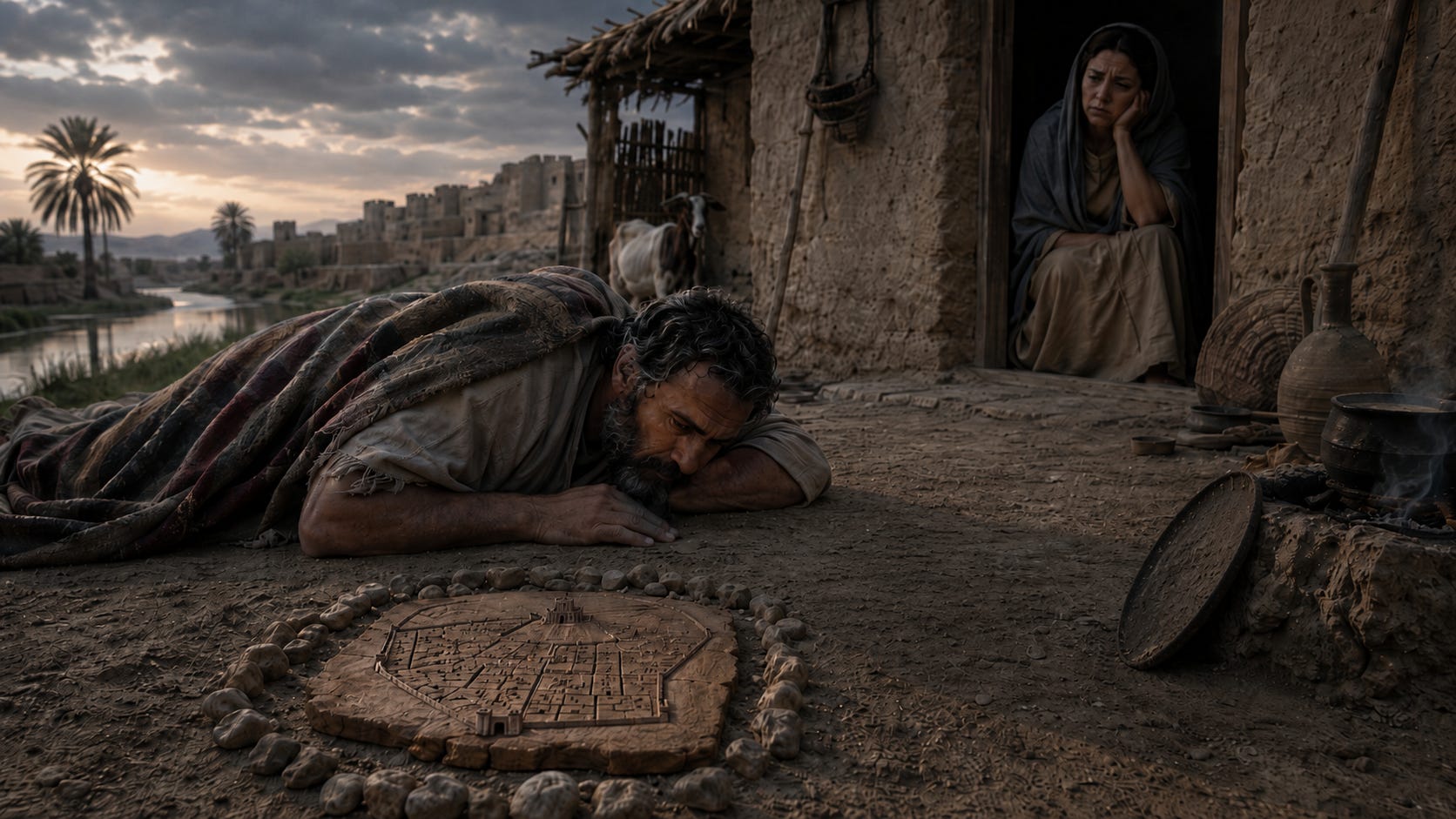
In the yard, by the side of the oven, his wife had a pile of clay set aside to mend the oven floor where it had cracked in the dry season. The man knelt beside the pile and took up a handful. The clay was cool in his palms and held the print of his fingers where he had closed them. He worked it. He flattened it. He smoothed it with the heel of his hand and pressed it into a rectangle, and when the rectangle was even and the size of two open hands set together, he laid it on the ground in front of him.
He picked up a sharp stone.
On the surface of the clay he drew lines. He drew a wall around a square. He drew the inner shape of streets. He drew the outline of a hill in the middle, and on the hill he drew the outline of a building. He drew gates in the wall, and outside the gates he drew the ditch, and outside the ditch the road that came down from the north.
When he was finished he set the stone down.
His wife had come out into the yard when the elders had come out, and she was watching not the brick but her husband. She was watching the way his hands moved over the clay. His hands were steady, and they had not been steady in three days. They moved now the way the hands of a man move at a craft he has long known.
Buzi had crouched down beside the brick. The other three of them were standing. None of them was speaking.
Buzi knew the shape. He had stood inside the building on the hill. He had walked those streets with his father, and with his father’s father, on the days of the feast. He had eaten the meat of the offering in the courts of that building. He had laid his face upon the stones of its floor.
Buzi said: Why have you made the city.
The man did not answer.
He picked up small stones from the yard and placed them around the brick. He set them carefully and evenly in a ring, one against the other, so that no gap remained in the ring.
Then he stood, and he went to the cooking place. His wife had a flat iron pan there that she used for the baking of unleavened bread. He took the pan and brought it back to the brick, and he set it on its edge between himself and the brick so that it stood like a wall between him and the city he had drawn.
He lay down on his left side, facing the brick, with the pan between them.
He closed his eyes.
The youngest of the merchants laughed, and then he stopped.
The thinner priest knelt beside the man and put a hand on his shoulder, and he spoke close to his ear. The man’s eyes did not open. The thinner priest took his hand away and stood up, and he looked at Buzi. Buzi did not look at him.
The young merchant said, He has gone out of his mind.
The older merchant said, We came for an answer and we are leaving with this.
Buzi said, This is the answer.
The young merchant made the impatient noise again and turned and walked out of the yard, and the older merchant followed him. The thinner priest stood a while longer. He looked once at the wife in the doorway, and she did not speak to him and he did not speak to her, and after a while he left as well.
Buzi went last. At the gate of the yard he stopped and looked back at the man lying on his side with the pan between him and the brick. Buzi’s hand was at his mouth. He stood there a long moment. Then he turned and walked down the path toward the lower huts.
The wife came down into the yard then, and she stood and looked at her husband, and at the brick, and at the iron pan set between them. She did not approach him. She wiped her hands on her apron.
She went back inside.
She came out again with a blanket and she laid it over him, because the wind in those afternoons came down the canal from the north and it would be cold against his back as the day cooled. She did not move the pan or the stones or the brick. She arranged the blanket so that it covered his shoulder but not the city he had made.
Then she sat in the doorway and watched him a long time.
Toward evening the goats came in from the canal of their own accord, ahead of the boy who tended them. They came up the path and stood at the gate of the yard, but they did not enter. They stood at the gate and looked at the man lying on the ground and at the brick on the ground in front of him.
The boy arrived behind them out of breath. When he saw the man on the ground he stopped, and he looked across the yard at the wife in the doorway.
She said, Take them around.
The boy took them around to the other side of the house.
The man did not move.
His wife sat in the doorway until the light had gone out of the sky. Then she rose and went inside and closed the door behind her.
She did not light the lamp. She sat on her mat in the dark and listened. The wind had risen, and it was moving against the side of the house and against the door and against the things that had been left in the yard. She thought she heard the iron pan turning on the ground. She was not certain of it. She did not open the door to look, because she did not want to be the one who looked. Once in the night she heard a sound that might have been her husband shifting his weight against the ground, and she rose halfway from her mat and listened. The sound did not come a second time. She lay back down. She did not sleep until the light came.
In the morning he was still in the yard. The blanket had slipped down from his shoulder in the night and she straightened it without touching his face. She went to the cooking place and made bread, and when the bread was warm she brought a piece of it out and set it on the ground next to the brick. The bread sat there. She took it back inside at the middle of the day, and she made a meal for herself and ate it standing in the doorway, watching him in the yard.
A woman from the next house came up the path then with a clay jar, to ask whether she might have any oil to spare. The woman stopped at the gate when she saw the man on the ground and the brick and the pan. She did not come into the yard. She set her empty jar down on a stone outside the gate.
He has been there since yesterday, the wife said.
The whole camp is talking, the woman from the next house said.
The wife did not answer her at first.
What have they said about it, the woman from the next house asked.
The wife said, You should go home.
The woman from the next house picked up her jar and went home.
In the afternoon Buzi came back, alone this time. He stood at the gate and looked at the man on the ground. He did not come in. After a while he raised his hand toward the wife in the doorway, and she inclined her head to him. He stood at the gate a while longer. Then he turned and went back down the path.
Two children came to the gate before evening. They had been sent by their mothers, or they had not been sent and had come of their own. They stood at the gate and looked. One of them, a boy of perhaps seven years, asked the other what the man was doing. The other one did not know. The first boy said the man was praying. The second boy said the man was sick. They argued in low voices at the gate and did not come into the yard.
The wife came out of the doorway and stood between the children and her husband.
Go home, she said.
The children went.
She stood in the yard a moment longer after they had gone, and she looked at the brick. She had not looked at the brick directly since the elders had left the day before. She had walked around it. She had stepped over the ring of stones. She had laid the blanket on her husband’s shoulder without looking at what he had made.
She looked at it now.
She knelt down beside the brick. She had walked those streets with her mother in the days of the feast, when she was a girl. She had stood on the steps of the building and watched the smoke rise from the altar in the afternoons. She had laid her face down upon the stones of its floor, the same stones her husband had laid his face upon when he was a boy.
She set her hand on the iron pan that stood between her husband and the city he had drawn. The iron was cold from the wind.
From all of us here at the Elephant Island Chronicles, we hope you have enjoyed this short story by Ian Moreno. Until next time, stay curious.
Do you like what you read but aren’t yet ready or able to get a paid subscription? Then consider a one-time tip at:
https://www.venmo.com/u/TheCogitatingCeviche

Ko-fi.com/thecogitatingceviche