Foreword by Gio Marron
Arthur Conan Doyle is remembered first, and often almost exclusively, as the creator of Sherlock Holmes. That is understandable, but it is also somewhat unfair. Doyle’s imagination ranged far beyond Baker Street. He wrote historical novels, ghost stories, medical fiction, war commentary, spiritualist works, and adventure tales. Among those adventure tales, The Lost World remains one of his most enduring and influential.
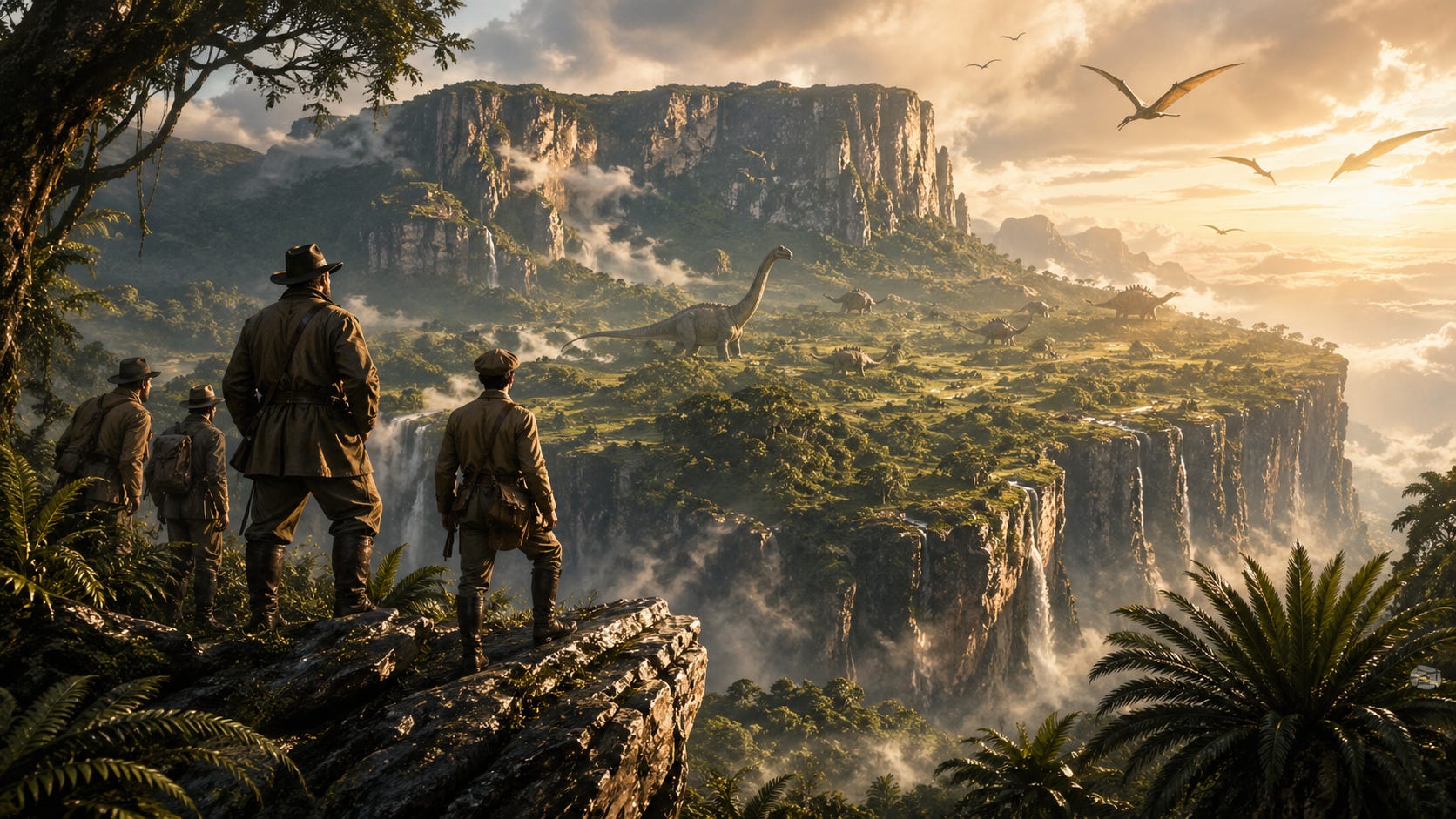
First published in 1912, The Lost World arrived at a moment when science, empire, journalism, and popular entertainment were colliding in the public imagination. The nineteenth century had filled maps, museums, lecture halls, and newspapers with reports of strange animals, distant peoples, fossil discoveries, and expeditions into territories described by European readers as mysterious or unknown. By the early twentieth century, the age of heroic exploration was already beginning to feel both thrilling and old-fashioned. Doyle captured that moment perfectly. He gave readers a story in which modern men, armed with scientific ambition, professional pride, and plenty of human vanity, step into a place where prehistoric life still rules.
The novel introduces Professor George Edward Challenger, one of Doyle’s great comic and dramatic creations. Challenger is brilliant, combative, theatrical, and nearly impossible to endure. He is not the cool rationalist that Holmes is. He does not persuade through quiet deduction. He thunders, insults, argues, and overwhelms. Yet beneath the bluster lies real intelligence and real courage. Doyle clearly enjoyed writing him, and that enjoyment carries into every scene in which Challenger appears.
The narrator, Edward Malone, gives the story its human entry point. He is young, ambitious, romantic, and eager to prove himself. His desire for adventure begins almost absurdly, as an attempt to impress a woman who wants a man of action. Yet that shallow motive leads him into danger, wonder, and discovery. Through Malone’s eyes, the reader experiences the journey not as a dry scientific report, but as a tale of amazement, fear, rivalry, humor, and survival.
Modern readers will notice that The Lost World reflects many assumptions of its time. Its language, attitudes toward exploration, and depictions of Indigenous peoples belong to the world in which Doyle wrote, not to ours. Those elements should not be ignored. They are part of the historical texture of the book. At the same time, the novel’s central imaginative power remains clear: the fantasy that somewhere, hidden beyond the reach of ordinary maps, the ancient world might still be alive.
That idea has never really left us. Doyle’s plateau, filled with dinosaurs and impossible survivals, helped shape a long tradition of adventure fiction and speculative storytelling. Later works about hidden lands, isolated ecosystems, living fossils, dangerous expeditions, and prehistoric creatures owe something to The Lost World. Its influence can be felt in novels, films, comics, games, and every story that begins with the question: what if there is still a place where the past has not ended?
The pleasure of this book lies not only in its monsters, though they certainly matter. It lies in the tension between certainty and wonder. Doyle places confident men of science in a world that exceeds their categories. He lets ambition become comedy, skepticism become awe, and civilization become fragile. The expedition is a test not only of courage, but of humility.
To read The Lost World today is to enter a grand adventure from the early age of modern popular fiction. It is brisk, theatrical, sometimes dated, often funny, and still capable of wonder. It reminds us that discovery has always been partly about evidence, partly about imagination, and partly about the dangerous human need to see what lies beyond the next ridge.
Arthur Conan Doyle gave the world Sherlock Holmes, but in Professor Challenger and his impossible plateau, he gave it another lasting gift: a vision of science as adventure, and of adventure as the place where arrogance, fear, courage, and wonder meet.
Gio Marron
Video by Gated of Imagination YouTube channel*
Narrated by Arthur Lane
*Not affiliated with The Elephant Island Chronicles.
Text courtesy of Project Gutenberg: The Lost World
Also available on Amazon: The Lost World
The Elephant Island Chronicles is a reader-supported publication. To receive new posts and support my work, consider becoming a free or paid subscriber.
Do you like what you read but aren’t yet ready or able to get a paid subscription? Then consider a one-time tip at:
https://www.venmo.com/u/TheCogitatingCeviche

Ko-fi.com/thecogitatingceviche