

Foreword to “The Star”
By H. G. Wells
H. G. Wells’s “The Star” first appeared in The Graphic in December 1897 and was later collected in Tales of Space and Time in 1899. It belongs to Wells’s early and extraordinarily productive period, when he was helping define what modern science fiction could become: not merely adventure dressed in machinery, but speculation as moral shock. (American Literature)
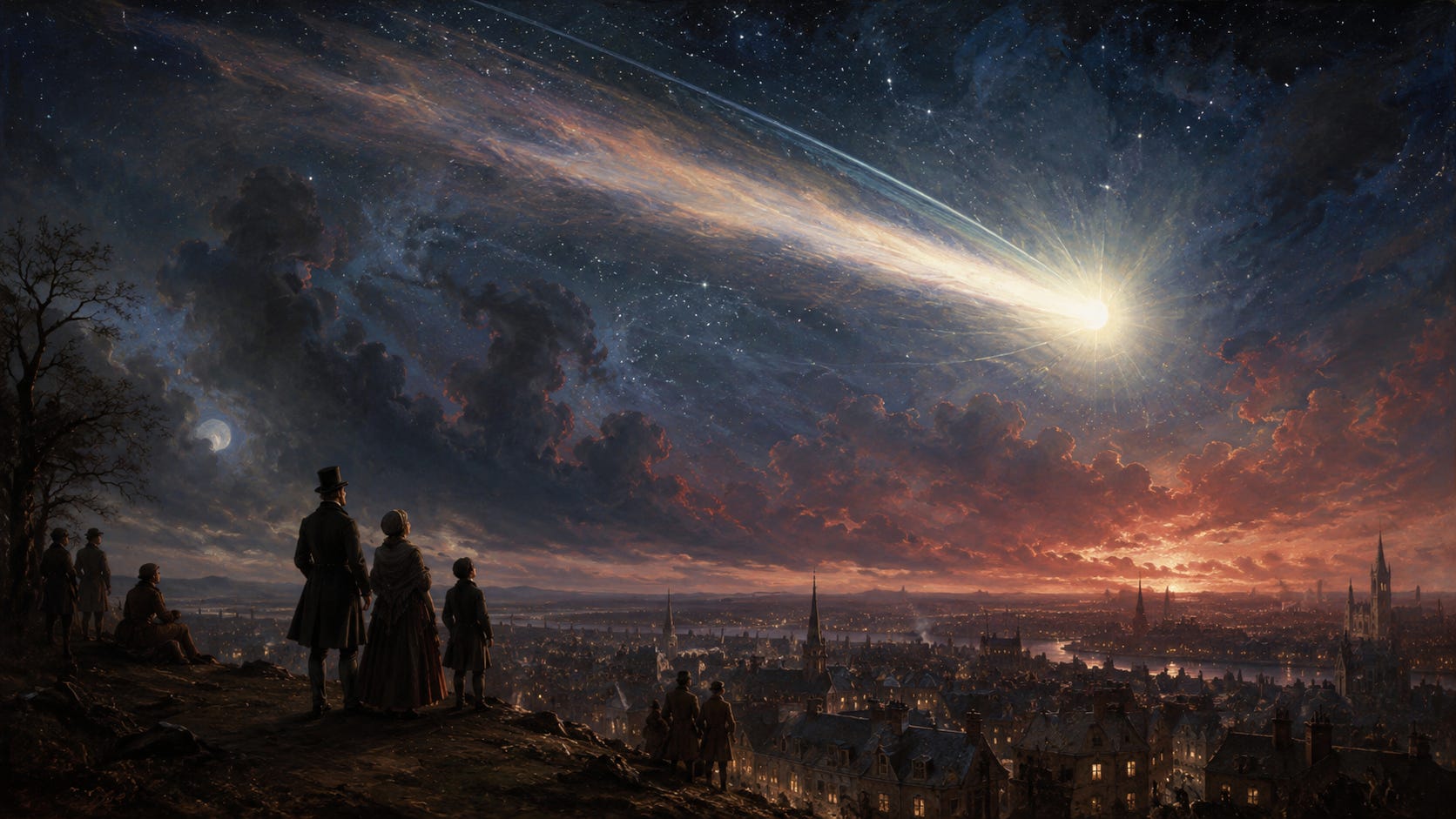
“The Star” begins with a simple astronomical disturbance. Something has gone wrong in the heavens. A bright intruder has entered the solar system, altering the expected movement of distant planets and drawing the attention of those few people who know how to read the sky. At first, this is an event for specialists: astronomers, mathematicians, and observatories. But Wells understood something essential about catastrophe. It rarely remains the property of experts for long.
Soon the strange body in the sky becomes public knowledge. It is seen, discussed, feared, dismissed, interpreted, and misunderstood. Some look upward in awe. Some turn to religion. Some shrug and continue with their errands. Some trust official reassurance. Others sense, correctly or not, that the ordinary scale of human life has been violently interrupted.
That is where the story’s power lies. Wells does not simply ask what would happen if a cosmic body threatened Earth. He asks how human beings would behave under a sky that no longer seemed stable.
Late Victorian fiction often had a taste for disaster, invasion, and collapse. Wells used those forms better than most because he rarely treated destruction as spectacle alone. In his hands, catastrophe becomes an instrument for reducing human pretension to its real size. Empires, markets, parliaments, cities, reputations, and private anxieties all seem permanent until they are placed beside the cold mechanics of space. “The Star” is not anti-human, but it is unsentimental. It reminds us that civilization is real, precious, and fragile, but not central to the universe.
The story also carries one of Wells’s recurring tensions: confidence in science, paired with suspicion of human complacency. The scientists in “The Star” are not fools. They observe, calculate, and revise. Knowledge matters. Yet knowledge does not guarantee calm, nor does it guarantee timely action. Information moves unevenly through society. Some understand too late. Some deny too long. Some are right for the wrong reasons. Some are wrong with impressive confidence.
That pattern feels familiar. We live in an age saturated with warnings, models, forecasts, alerts, expert panels, and public arguments over risk. We know more than any previous generation, yet we are not always wiser in proportion to what we know. Wells saw that problem early. A warning is not merely a fact. It must pass through pride, fear, politics, habit, and the ordinary human desire to believe that tomorrow will resemble yesterday.
“The Star” also works because of its scale. Wells moves from observatories to streets, from private rooms to continents, from the technical to the biblical, from the minute to the planetary. He was one of the great writers of perspective. He could make the reader feel both the sweep of cosmic force and the smallness of a human gesture under pressure. That double vision gives the story its force. The great disaster is vast, but it is experienced by individuals: by people looking from windows, gathering in crowds, calculating in solitude, praying, denying, waiting.
Modern readers may notice how much of the story anticipates later disaster fiction. The global event, the expert warning, the divided public response, the sudden shrinking of ordinary concerns, the uneasy mixture of science and apocalypse: all of these now feel familiar. Yet Wells reached them before they hardened into formula. “The Star” retains the freshness of discovery because it is not overloaded with technical explanation or sentimental heroism. It is lean, direct, and severe.
There is also a strange beauty in it. The object that threatens Earth is not merely a monster. It is luminous. It inspires wonder before it inspires terror. Wells understood that the universe does not need malice to endanger us. It can be beautiful and deadly at the same time. That is a harder truth than villainy. A villain can be opposed. A cosmic event can only be understood, endured, or escaped.
Reading “The Star” now, we may find ourselves less interested in whether Wells’s astronomy is exact than in whether his human observations still hold. They do. We still argue over warnings. We still mistake distance for safety. We still imagine that normal life has a kind of legal claim on the future. We still look upward, literally or figuratively, and wonder whether the bright thing approaching us is marvel, judgment, accident, or all three.
“The Star” is brief, but it leaves a long shadow. It belongs to the branch of science fiction that does not flatter us. It does not say that human cleverness will always prevail, nor does it say that human life is meaningless. It says something sterner and more useful: we are small, but not trivial. We are vulnerable, but capable of understanding. We live under forces we did not create, yet we remain responsible for how we face them.
That is why the story endures. Wells gives us the night sky not as decoration, but as a correction. Under it, all our certainties are revised.
Gio Marron
Video by Sci-Fi Hub YouTube channel*
Narrated by Unknown
*Not affiliated with The Elephant Island Chronicles.
Also available on Amazon: H.G. Wells - The Star
The Elephant Island Chronicles is a reader-supported publication. To receive new posts and support my work, consider becoming a free or paid subscriber.
Do you like what you read but aren’t yet ready or able to get a paid subscription? Then consider a one-time tip at:
https://www.venmo.com/u/TheCogitatingCeviche

Ko-fi.com/thecogitatingceviche