Voice-over provided by Eleven Labs
The Tenant
By Mauve Sanger
Nora cleaned the bathroom sink with a rag she would throw away afterward. The porcelain was white and the faucet was chrome and neither had been this way in months. She wiped the mirror. Her face appeared, then the room behind her, then the towel rack she had emptied that morning. The hooks were bare. She had taken down the blue towels and folded them into a garbage bag with everything else from the linen closet.
The apartment was on the second floor of a building on Maple Street. Two bedrooms, one bathroom, a kitchen with a window over the alley. She had lived here for four years. The lease ended on the fifteenth.
Wednesday she had placed the ad. Three people were coming today, the first at ten.
In the kitchen she checked the counters. She had cleared them the night before. The toaster was in a box in the hall closet. The knife block, the ceramic jar that held wooden spoons, the cutting board that leaned against the backsplash. All of it packed or removed. The counters were clean granite, gray with darker flecks, the surface of a place no one had cooked in. She ran her hand across the stone. It was cold and smooth and told you nothing.
The buzzer rang at ten past ten.
The couple was young. The woman had short hair and a canvas bag over one shoulder. The man wore glasses and kept his hands in his coat pockets. They stood in the doorway and took in the apartment behind Nora.
“It’s bigger than I expected,” the woman said.
Nora stepped aside. They moved through the living room. The woman went to the window and studied the street below. The man opened the coat closet near the door, peered in, closed it.
“How’s the light in the afternoon?” the woman asked.
“The front room gets sun until about three,” Nora said. “The bedroom faces east. Morning light.”
“And the neighborhood?”
“Quiet. There’s a grocery store two blocks south. A laundromat on the corner of Fifth.”
The man was in the kitchen now. He ran the faucet on and off. He opened the cabinet under the sink and checked the pipes.
“Any issues with the plumbing?” he asked.
“No.”
He closed the cabinet. The woman’s footsteps sounded from the bedroom, crossing the hardwood, a pause, then more steps. She came back.
“There are marks on the bedroom wall,” the woman said. “From shelves?”
“Yes.”
“Did you have a lot of shelves?”
“A few.”
The woman glanced at the man. Something passed between them, a calculation Nora was not part of. They thanked her and left. Nora listened to their footsteps going down the stairs, the front door opening and closing. She stood in the living room. The room was large and empty and held nothing of the conversation that had occurred in it.
She sat on the floor against the wall. The carpet had been here when she moved in. Beige, commercial grade, flattened in the paths between rooms. There was a darker patch near the kitchen doorway where she had spilled coffee two years ago, a Sunday morning in October. She had cleaned it with dish soap and water. The stain had faded but the texture changed, stiffened, a record of the spill and the cleaning and the morning that continued afterward.
She did not think about the morning. The stain was a stain. Nothing more.
On the living room wall, near the baseboard, a scuff mark she had never seen before. Black, the width of a shoe heel. It could have been hers. It could have been from before she moved in. The wall would be painted over before the next lease. The mark would disappear with everything else.
At noon, the second visitor. A woman in her fifties with a gray wool coat and a folder under her arm. She introduced herself as Diane. She moved through the apartment with a different kind of attention, opening every door, checking every window latch, pressing her palm against the bedroom wall as though testing for something behind it.
“The closets are small,” Diane said.
“They are.”
“Is there additional storage in the building?”
“There’s a basement unit. You can rent it for thirty a month.”
Diane wrote this down. In the bathroom she checked the ceiling for water damage. Nora told her there hadn’t been any. Diane asked how long Nora had been here.
“Four years.”
Diane’s gaze came to rest on Nora. It was brief, assessing, a question that did not get asked. Why are you leaving. Nora did not answer what had not been spoken.
“The heat is included?” Diane said.
“Heat and water. Electric is separate.”
Another note in the folder. Diane crossed to the front door and paused with her hand on the knob.
“The ad said available the fifteenth.”
“That’s right.”
“Good.” Diane opened the door. “Thank you for your time.”
Nora closed the door behind her. In the kitchen she stood at the window. The alley was narrow, bordered by the backs of buildings on the next street. A fire escape on the opposite building, black iron, zig-zagging down the brick. A dumpster. A strip of sky above. Every evening while washing dishes she had stood here, watching. The dumpster had been green, then blue when they replaced it last spring, and now it was blue with a rust stain spreading down one side. The rust had grown through the summer and into fall. She did not know why she had tracked it. She had.
Lunch was a sandwich she had brought in a paper bag. Turkey on white bread. The kitchen floor was the only place to sit because the chairs were gone. The linoleum was cold through her jeans. A hairline crack ran through the grout between the floor tiles, from the base of the refrigerator to the edge of the counter. She had mopped this floor a hundred times and never seen the crack. Or she had seen it and not registered it. The difference did not matter.
The bread was dry. She finished it and drank water from a plastic bottle and put the wrapper and the bottle in the paper bag and folded the bag closed.
Between the refrigerator and the wall there was a gap of about two inches. She leaned sideways and saw, in the gap, a pen. Blue ink, the cap missing. She did not reach for it. It was not worth the effort. The next tenant would find it, or the cleaners would, or it would stay there for another four years. The pen did not belong to anyone now.
At two, the last visitor. A man, younger than the couple but not young, in a gray jacket with a phone in his hand. He gave the apartment the attention of someone who would be gone in a minute. He traced the perimeter of the living room, glanced into the bedroom, opened and closed the bathroom door without going in.
“Parking?” he said.
“Street parking. There’s a lot on Third, monthly passes.”
“How much?”
“I don’t know. I didn’t have a car.”
He checked his phone. “Okay.” He went to the front door. “I’ll let you know.”
He did not ask her name. She did not offer it. The door closed and his footsteps were fast on the stairs, already elsewhere.
The apartment was quiet now, a different quiet than it had been that morning. All day people had moved through it, asking their questions, running their hands along surfaces and opening doors, and now they were gone and the rooms had absorbed their absence the way they would absorb anyone’s. A radiator ticked in the bedroom. The refrigerator hummed. These were the sounds of the apartment when no one was in it, and they were the sounds of the apartment when she was in it, and there was no difference between the two.
In the bathroom, a water ring on the back of the toilet tank. She wiped it with her sleeve. Four years of setting a glass of water there before bed, and this was the mark. One pass of cotton and it was gone.
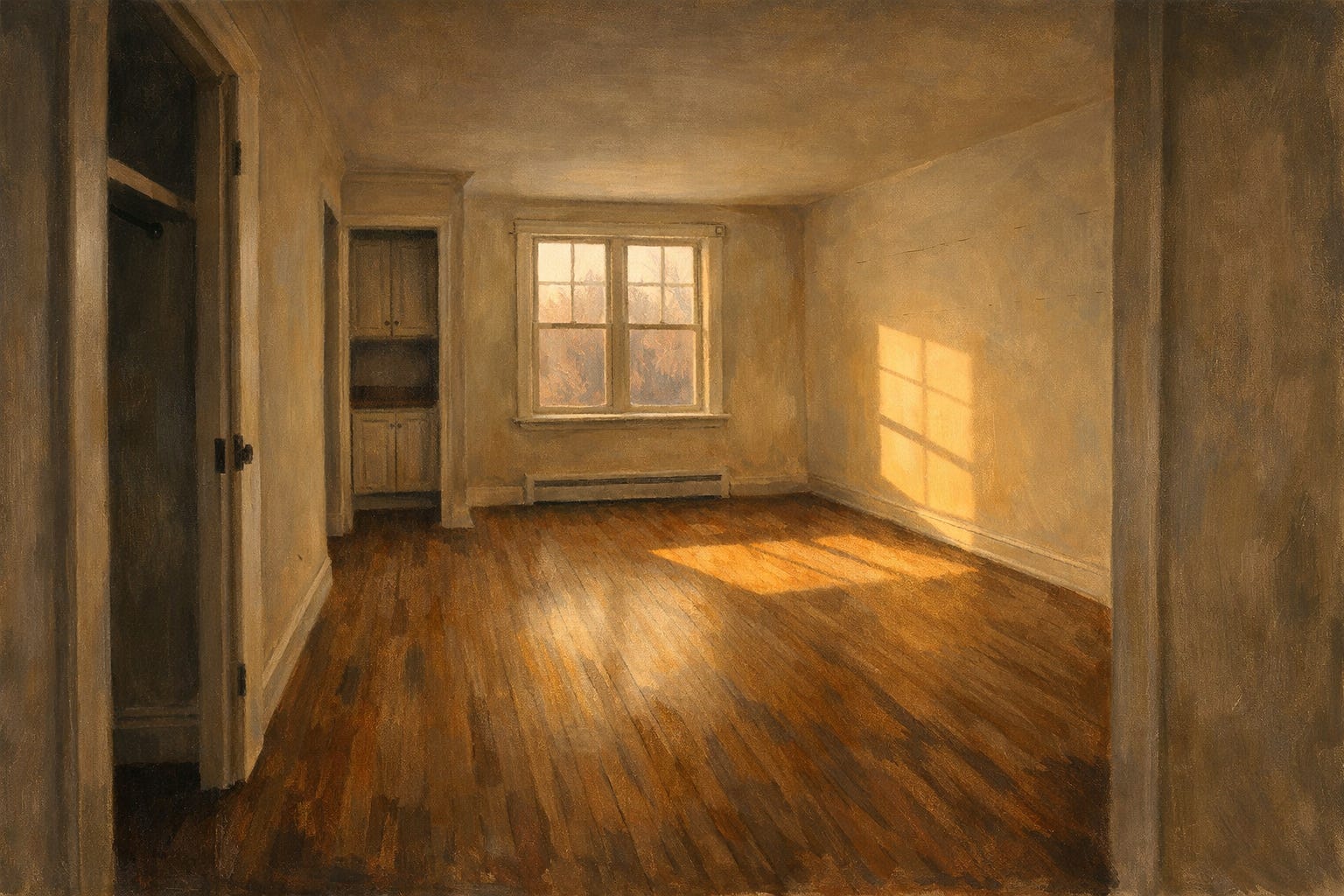
Nora stood in the living room. The afternoon light came through the front window and fell across the carpet in a rectangle that reached the far wall. Every day for four years this light had been here. It moved with the seasons, longer in summer, shorter and lower in winter, and now in early March it reached the baseboard at an angle that would steepen each week until June.
She went to the bedroom. The room was empty except for the marks on the wall where the shelves had been. Five holes, evenly spaced, filled with white putty that did not match the paint. The shelves had held books. Forty or fifty of them, paperbacks and a few hardcovers, arranged by nothing in particular. She had read in bed, a lamp on the floor beside the mattress, the mattress on the floor because she had never bought a frame. Four years without a bed frame. It had not bothered her. It had not occurred to her as something to fix.
The floor where the mattress had been was a different shade, the wood lighter there, protected from the sun that came through the east window each morning. A rectangle of paler oak in a room of darker oak. The shape of the mattress preserved in the floor like a fossil. It would fade with time. Or Diane, or the young couple, or whoever came next would put their own bed there and never see the difference.
The bedroom door closed. Then the bathroom, the coat closet, the kitchen cabinets. Everything that could be closed, closed. Then she went through the apartment once more. Living room. Kitchen. Bathroom. Bedroom. Each room was clean and empty and indifferent to her passage through it.
Her coat was on the counter by the door. She put it on, picked up the paper bag with the sandwich wrapper and the empty bottle. Two keys in her pocket: the front door of the building and the apartment. She would leave them with the landlord on the fifteenth. For now they were still hers.
The kitchen light went off. The living room had no overhead light, only the window. The bathroom was already dark. From the front door she faced the apartment one last time. Light from the window had reached the middle of the far wall. By five it would be gone.
She opened the door, stepped into the hallway, and pulled it shut behind her. The lock caught. She went down the stairs and through the front door and onto Maple Street, where it was cold and bright and the afternoon was half over.
From all of us here at the Elephant Island Chronicles, we hope you have enjoyed this original short story by Mauve Sanger. Until next time, stay curious.
Do you like what you read but aren’t yet ready or able to get a paid subscription? Then consider a one-time tip at:
https://www.venmo.com/u/TheCogitatingCeviche

Ko-fi.com/thecogitatingceviche