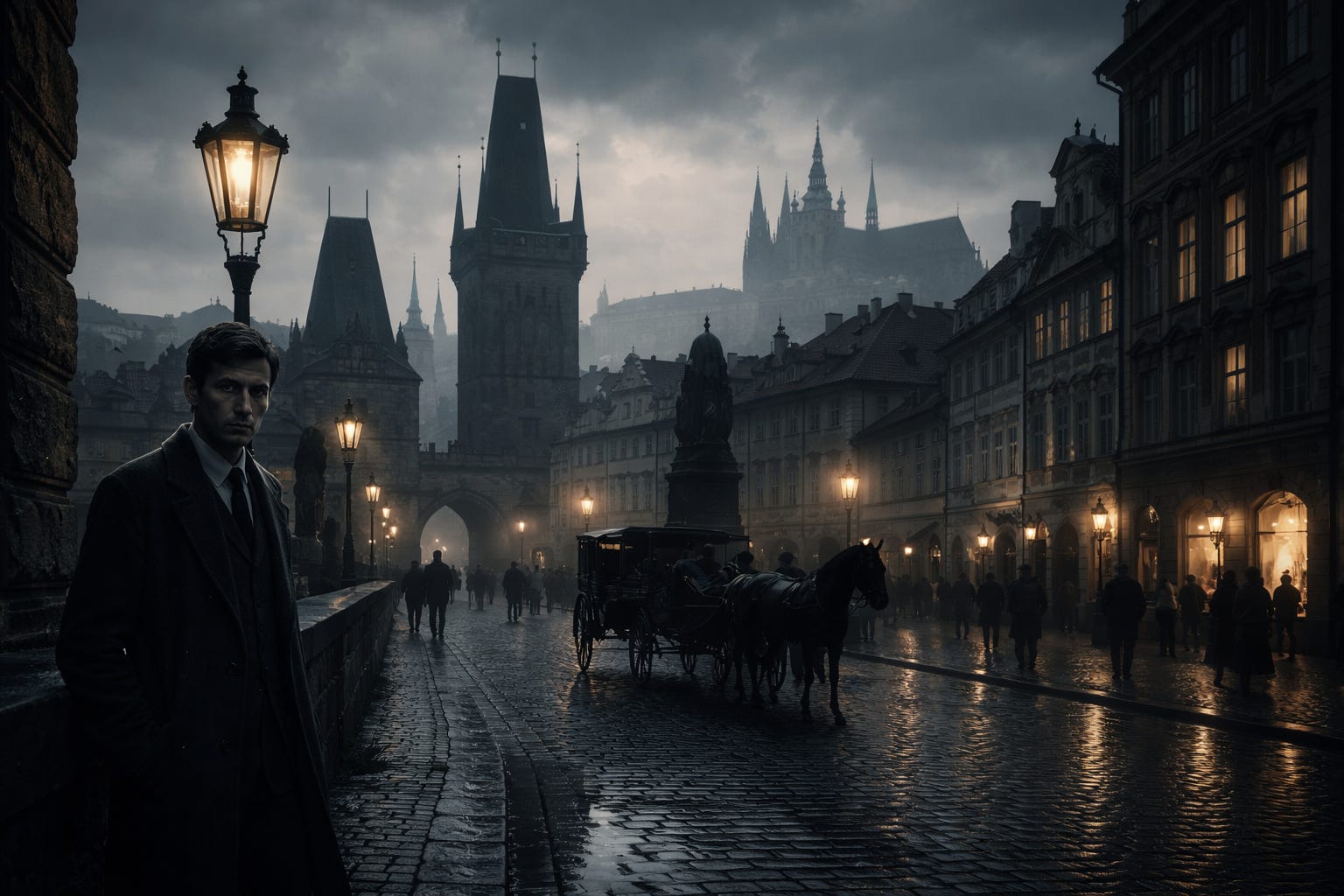
Foreword by Gio Marron
When The Trial was first published in 1925, a year after Franz Kafka’s death, it entered the world as an unfinished work. Kafka had instructed his friend and literary executor, Max Brod, to burn his manuscripts. Brod refused. Instead, he edited and arranged the fragmented chapters into the version readers now know. The novel’s very existence is an act of defiance against oblivion, a testament to the uneasy alliance between authorial intention and literary legacy.
At its simplest, The Trial tells the story of Josef K., a bank official arrested one morning for a crime that is never named. He is not imprisoned, nor is he told what law he has broken. He is merely informed that proceedings have begun. From that moment forward, his life is infiltrated by a court that is everywhere and nowhere: lodged in attics, hidden behind ordinary doors, carried out by minor officials who seem at once petty and omnipotent. The machinery of accusation turns without explanation.
Kafka’s genius lies not in dramatic revelation but in the quiet normalization of absurdity. The novel does not explode into chaos; it tightens. Each encounter deepens the sense that the system governing Josef K.’s fate is both impenetrable and intimate. Authority appears diffuse, yet absolute. Procedures exist, but their logic is inaccessible. Guilt hovers in the air long before any evidence is presented. The court does not need clarity. It requires only participation.
Much has been written about the novel as prophecy. Published in the shadow of collapsing empires and rising bureaucracies, The Trial has often been read as anticipating the totalitarian regimes of the twentieth century. Its labyrinthine offices and faceless officials resemble the administrative states that would later dominate Europe. Yet the book resists confinement to any single historical moment. Its power persists because it addresses something more enduring than a particular government or ideology.
Kafka understood the modern condition as one shaped by systems. Law, insurance, banking, employment, and civil administration all function through procedures that are rational in design but opaque in experience. Individuals move within frameworks they neither built nor fully grasp. The more procedural the world becomes, the less visible its moral center may appear. In The Trial, that absence becomes existential. Josef K. searches not only for acquittal but for meaning.
The novel’s atmosphere is marked by a distinctive emotional tension: a blend of anxiety, restraint, and strange comedy. The humor is dry, often unsettling. Officials bicker. Courtrooms double as tenements. The accused must navigate etiquette as carefully as he navigates law. Kafka’s restraint intensifies the effect. He does not describe terror with spectacle. He allows dread to accumulate through repetition, delay, and polite conversation.
Readers frequently ask whether Josef K. is innocent. The novel offers no answer. Indeed, the question may miss the point. Innocence in The Trial is not a stable category. It is something to be negotiated, deferred, or presumed irrelevant. The court’s authority does not depend on truth; it depends on process. This inversion remains unsettling because it mirrors a fear that institutions can operate independently of justice while still claiming its language.
Kafka wrote in German while living in Prague, positioned between cultural, linguistic, and political identities. His personal life was marked by self-doubt, professional discipline, and an acute awareness of authority, including his own fraught relationship with his father. These biographical elements illuminate the novel but do not exhaust it. The Trial transcends the particulars of Kafka’s life. It speaks to readers who have felt the quiet pressure of expectations they cannot name and obligations they cannot escape.
As an unfinished work, the novel resists tidy closure. Its episodic structure contributes to its disorientation. Chapters shift in tone and intensity, as though the narrative itself were subject to the same unstable logic as the court. The effect is deliberate, even if the final ordering was shaped by Brod. The lack of conventional resolution is not a flaw but an extension of the book’s central anxiety. In a world where explanation is perpetually deferred, certainty becomes another illusion.
To read The Trial today is to encounter a mirror that has only grown sharper. In an age defined by algorithms, automated decisions, and vast institutional frameworks, Kafka’s vision feels less surreal than diagnostic. The fear that one’s life can be redirected by systems beyond comprehension is no longer confined to fiction. Yet the novel does more than diagnose. It invites reflection. How do we respond when confronted with opaque authority? Do we resist, comply, rationalize, or internalize?
Kafka does not preach. He presents. The world of The Trial is rendered with precision and restraint, leaving readers to grapple with its implications. That is perhaps why the novel endures. It does not tell us what to think about law, guilt, or power. It compels us to feel their weight.
In preserving The Trial, Max Brod ensured that Kafka’s unsettling vision would outlive him. The novel remains unfinished in form, yet complete in effect. Its questions linger long after its final pages. And in that lingering unease lies its lasting power.
Gio Marron
Video by Gates of Imagination YouTube channel*
Narrated by Arthur Lane
*Not affiliated with The Elephant Island Chronicles.
Also available on The Trial
The Elephant Island Chronicles is a reader-supported publication. To receive new posts and support my work, consider becoming a free or paid subscriber.
Do you like what you read but aren’t yet ready or able to get a paid subscription? Then consider a one-time tip at:
https://www.venmo.com/u/TheCogitatingCeviche

Ko-fi.com/thecogitatingceviche